
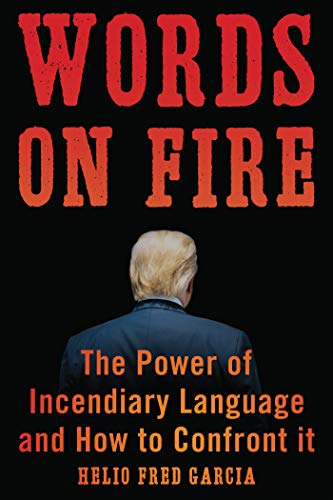
Words of Fire brings together a broad range of disparate questions in my mind. Among the longest standing is the Isaac Asimov theory that mathematics could be used to predict the future. Another puzzle that I thought was unrelated was the inexplicable rise in gun violence. When I was a child in the northwest, there were several guns in every house and a gun in most vehicles, often hanging in the back window of trucks. Another anomaly I have thought about often is the relationship between language and violence, including why Charles Manson was imprisoned for life even though he never actually killed anyone. Additionally, I have wondered often about disinformation and misinformation and their impact on democratic institutions worldwide as well as the possibilities of a link between misinformation and a violent kinetic response. Helio Fred Garcia just put all of these seemingly random ponderings into one coherent whole.
For those who know little about Isaac Asimov, they might think it’s not reasonable to expect a science fiction author to know much about reality, but avid science fiction fans know that he was a scientist and that’s what made his writing so compelling. What’s more, he wrote the script that shaped much of the modern scientific development from talking robots and AI to the voice user interface revolution we are now experiencing. However, the theory that most fascinated me in the early 1980s was in his series called Trilogy, in which a scientist uses mathematics to predict the future, not of one individual, but in broad brush strokes. I majored in sociology and I’ve often pondered how we might make Asimov’s theory a reality. Reading Words on Fire, I realized it already happened. I just spent one of the most fascinating years of my professional life with the U.S. Army Corps of Engineers which makes extensive use of mathematic models to predict hurricane movements. They applied their science to the coronavirus, working to determine where the hot spots would likely be, when and how many medical patients would likely need care. They compared those numbers to the capacity of hospitals in those areas and worked with the state governments to build alternative care sites to help with surge capacity. Even though I have been sitting in those briefings for six months, I never realized they are the realization of Asimov’s theories I read as a child.
Fred Helio Garcia introduced me to a new term. Sto·chas·tic, defined by Oxford Languages as “randomly determined; having a random probability distribution or a pattern that may be analyzed statistically but may not be predicted precisely.” And the phrase stochastic terrorism, apparently something the FBI has long considered since the lone wolf scenario is remarkably difficult to detect and prevent. The stochastic terrorism model is a stochastic process, a random, model of those terror attacks intended by the random nature of their timing and targets to excite a generalized fear per Wikipedia. Fred isn’t the only author to connect language and the recent rise in terrorism. Wired Magazine and Quartz business magazine also observed this phenomenon in 2018 and 2019. Once I knew the term, it seems the internet is full of references. Fred says, “The name stochastic terrorism is drawn from a principle in statistics about seemingly random things still being predictable. Despite the unfamiliarity many people have with the word stochastic, the name caught on in the aftermath of the 2009 killing of Dr. Tiller, an abortion doctor. While the specific actors might not have been predictable, some kind of violent action could be mathematically determined to have a high probability based on a rise in violent rhetoric related to abortion services.
While the seemingly endless stream of horrifically violent acts seems to logically lead to stricter gun laws, that logic fails for me. Born in 1967, my youth was full of guns and I was unaware of any gun violence. I certainly never practiced drills at school to prepare for an active shooter. So what has changed? We have these standard mantras like guns don’t kill people, people kill people, but what has amazed me is how many people are not only using guns, but also cars to intentionally drive into crowds of people. Yes, people are killing random strangers recently, but why? Historically in the US, violence has been related to interpersonal relationships that went sour, gangs and/or mafia, as well as domestic violence. But random killing of strangers seems like an odd behavior to me. And even if we restrict guns, which I favor when regarding what I call weapons of mass destruction such as the Gatling gun or the .50 cal, I don’t see that as a solution that will reduce the number of people who want to kill random strangers. It would only reduce their total kill capability. So why are we seeing an increase in mass shootings?
I had come to the conclusion that we need mental illness control, not gun control. However, Fred illustrates that mental illness, while a contributing factor, is only a small slice of the story, which he calls the Lone Wolf Whistle. Fred lists 12 forms of language that contribute to violent acts – dehumanize, demonize or delegitimize, scapegoat, public health threat, safety threat, violent motive, exaggerated risk, sinister identity, conspiracy, discredit information, conflation, menacing image. For me, several of these overlap. It’s a well-known sociological theory that the worst forms of violence happen between groups of people. Sociological limitations require proper conduct when dealing with people we feel are part of our group. Norbert Elias, a German Jew with a front row seat to one of the world’s worst examples of human horror observed that the worst forms of violence happen between groups. As such, it is a critical first step to alienate, dehumanize, or delegitimize a person or group of people to make violence possible. This has unfortunately been a part of military operations in the US for as long as we have been a nation. The range of vulgar terms applied to foreign combatants is necessary for soldiers to be able to shoot.
It’s not enough to say, “They” are not like us. The second critical step is, they must be a threat. They must be the cause of current or potential ills, including physical or physiological safety. And particularly when targeting a group, conspiracy contributes to this treat issue, making the entire group part of the threat. If a group poses a threat, taking action not only doesn’t seem barbaric, it seems logical.
The mental health connection is that people who already have a tenuous grasp on reality and/or limited ability to curb impulses are the ones most likely to take the logical action presented by the alienating language that develops a threat from a given group of people, such as abortion doctors who are “committing murder” in the case of the previously discussed Dr. Tiller. As a result, I realize it’s not the guns that have changed, it’s the language illustrating a pressing need for violent action and illustrates the link between language and action.
Manson was imprisoned because he ordered murders. However, no one that Fred examines was ordered to murder anyone. Fred examines one case in detail that stands out strongly in my mind regarding a young man with a decidedly disturbed childhood who drove halfway across Texas to “kill Mexicans” in El Paso. I remember the case well because Latino friends were appalled, but I wanted more information: He had a rape list and a kill list in high school. I don’t think that’s normal. Fred details the links between news about El Paso holding border crossers, Trump’s recent visit to El Paso and according to the shooter’s manifesto, the triggering event was the “invasion” of Texas by a “caravan” of illegal immigrants.
But there’s more than just words. Fred explains that Hamm and Spaajj harvested patterns that detail the 5 stages of radicalization. They include personal and political grievance, an affinity with extremist groups (in this case White Supremacists), identification with an enabler (in this case President Trump), broadcasting terrorist intent and a triggering event.
Fred observes as many technology thought leaders have observed that one of the unintended consequences of the Internet is that fringe members of society can now find a place with others who think like them. This sense of belonging to a higher purpose can be a contributing factor in the violent kinetic response to misinformation.
The last and most critical element in this explosive cocktail is its potential long-term impact on geopolitical realities. According to one of my many colleagues who have studied public relations and audience segmentation, the Russian government has taken the “soccer mom” persona creation to a whole new level by micro segmenting U.S. society in ways that make the direction of disinformation more lethal. My reading of the Mueller report was that it had nothing to do with the election or politicians. The overriding goal was a change in the standard “US as the Great Satan” narrative. In order to effectively convince their own population that an authoritarian government is better than a democratic one, Russia needed to create the impression that democracy is anarchy waiting to happen. Among the ways they have done this is with fake social media personalities on both side of the alt left and right. These accounts are used to encourage people to protest and then this state sponsored disinformation campaign stirs up the opposition to have a counter protest. They are specifically trying to set up the conditions for random violence.
Fred focuses on the language of U.S. political leadership in the last few years, but his analysis doesn’t go far enough. Because the real enemy isn’t here inside our borders. The real enemies are cherry picking the comments that Fred is worried about and amplifying them to specific targeting audiences who will be most likely to respond to the lone wolf whistle. In addition to dangerous language, we have dangerous algorithms specifically working to provide fuel for violent acts. Our adversaries present a world in which U.S. leadership is neither desirable nor viable. Russia wants to undermine the concept of democracy as a desirable form of government. That government hopes to present an image of democratic nations as inherently unstably and physically unsafe. Thereby making authoritarian governments appear to be a better option.
The EU commission has repeatedly written about the destructive potential in disinformation. “Disinformation is ‘verifiably false or misleading information created, presented and disseminated for economic gain or to intentionally deceive the public’. It may have far-reaching consequences, cause public harm, be a threat to democratic political and policy-making processes, and may even put the protection of EU citizens’ health, security and their environment at risk. Disinformation erodes trust in institutions and in digital and traditional media and harms our democracies by hampering the ability of citizens to take informed decisions. It can polarize debates, create or deepen tensions in society and undermine electoral systems, and have a wider impact on European security. It impairs freedom of opinion and expression.”
One challenge with the language that Fred accurately identifies as dangerous is that it can be used both for the conscious purpose of division and for genuine opposition. Immediately after reading Words on Fire, I read Fauci. In it, gay men accused Dr. Fauci of murder because he religiously followed an antiquated, but widely accepted prolonged process for drug approval. Being accused of murder, an allegation that I thing the emotional people subjected to a deadly disease genuinely believed, cause Fauci’s attention. He reached out, befriended and learned from the community that called him a murderer. He subsequently rebelled against the established medical community and helped thousands of gay men get expedited access to critical medications, albeit, not proven.
In the Fauci case, I think the language was used genuinely. In the cases described by Words on Fire, the language was used for effect. So, in the end, what we have is a ruling that language shouldn’t be used to deceive and incite people, but it would be remarkably difficult to shape a law that follows this. Much like I know it when I see it. The phrase was used in 1964 by United States Supreme Court Justice Potter Stewart to describe his threshold test for obscenity in Jacobellis v. Ohio. So while we have no legal law, we can certainly develop a social repulsion at barbaric language which incites and encourages violence.
 35-Year Public Affairs & IT Professional