There’s an app for that: Weight loss & technology


It might seem crazy to talk about weight loss by talking first about sleep quality and second about technology, but they really set me up for success.

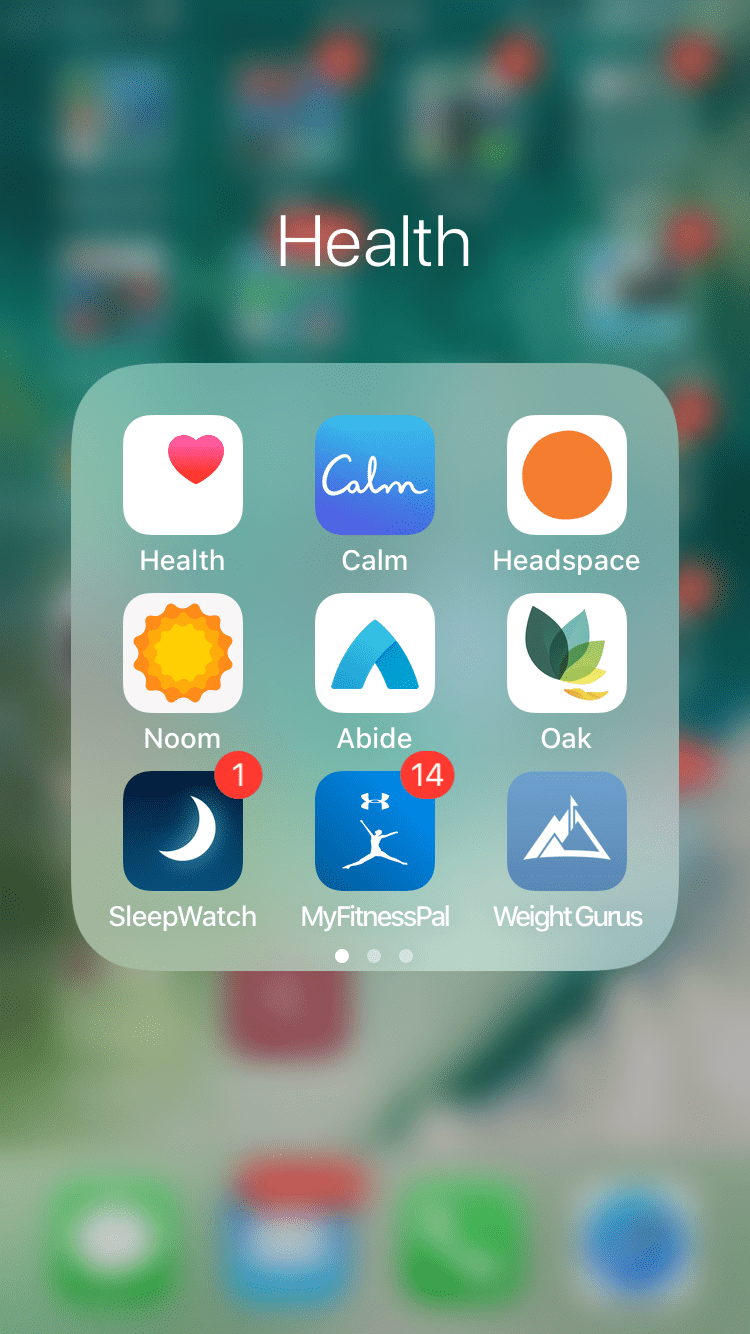
I have an iPhone with Apple Health app built in, but I don’t think this is the only technology available to provide the services it does. It’s just the one I know. The main function Apple Health serves is that it pulls in data from all the sources into a central location and then allows other apps, with my permission, to access my health data.

What health data?

Well, for starters, every morning after brushing my teeth, I step on my WeightGuru WiFi enabled scale that records my body weight, hydration level, bone density, BMI, and body fat percentage. All this information is then uploaded to the Weight Guru app and shared with Apple Health, which in turn shares the information with Noom. Subsequently, I never actually enter anything into Noom regarding my body weight. It all happens while I’m rubbing my eyes walking off into the shower.

I know have years of weight data ups and downs in the cloud that I can scan back and reflect on. Oh yes! We moved from Texas to DC, lived in hotels there and here, ate fast food. My weight went way up over those few months. And so on.

The previous post talked about how important sleep is
https://charlotteannhu.com/2019/11/16/diet-weight-loss-meditation-sleep/
And the SleepWatch app is a critical element in my ability to understand the impact and effectiveness of all my efforts to improve my sleep quality.

I have used MyFitnessPal for years on and off, but it’s a really wonderful way to track intake. The Noom staff noted that while the calories automatically transfer to Apple Health and Noom, the specific foods consumed do not, so if they are working on coaching eating habits, this automation doesn’t help. I haven’t had problems with my intake and I’ll talk about food specifically in another post, but the MyFitnessPal is critical to understanding what’s coming in and how much it’s worth in terms of calories, carbohydrates, protein, fiber, etc.

I mentioned the value of meditation in the previous post and since I had zero knowledge of meditation, I just use an app for that. I still don’t consider myself to have any understanding of meditation, but I love listening to the content on Calm, Oak, Abide, Headspace. The other night, Calm told me I had listened to their app 500+ times. Wow! I had no idea. I also love Amazon’s Audible and audiobooks. You might like podcasts, but I find that listening with my eyes closed is a great way to relax at night.

Noom exists solely in an app. Unlike other digital support systems like MyFitnessPal and WeightGuru which have corresponding websites, there is no website interface for Noom. It’s only available in an app.

So, get your tech set. Upload all your data into your apps. And even if you have zero plans to eat healthy, once you know exactly what you’re eating and how much you’re moving and how those two balance out, you almost can’t help but start tweaking it.

Early on with MyFitnessPal, I had a crazy urge to eat something delicious. But when I put it in the app, I was shocked how much calories, fat, sugar, etc. Then I considered whether a half of quarter serving of the same dessert might not hit the spot. I ate a fraction of what I was planning on eating and felt really happy with having eaten it. I undoubtedly would have eaten the whole thing if I hadn’t put it in the app first. I tend to do that a lot. I’ll think about eating something and wonder if it’s going to give me sufficient fiber or protein and if the numbers don’t add up like I want, I make another food choice.

That’s another detail. I don’t avoid carbs, fat, calories, etc. I chase protein and fiber. But that’s part of the food discussion, so I’ll cover that next time. For now, just set up your tech. Download all the apps. Tryout some meditation. Start logging food. Give your Apple Health permission to record your exercise, steps, hours standing, etc. Give it permission to share that information with your Noom app.

Buy a WiFi enabled scale. Step on it naked every day just after you wake up. Buy some kind of wearable (watch) that tracks your steps, health, heartrate, sleep quality. I talked about the options in the previous post: iWatch ($300?), FitBit ($140?) and HuaWise ($28).

Sleep & Tech 1st. Worry about food and exercise later.

Happy Health!

Diet, Weight loss, Meditation & Sleep

I didn’t take a New Year’s resolution for 2019, so I’m not exactly sure how it happened, but I dropped from 160 pounds to 135.

Let me try to recount the sequence of events not only for the readers, but because I haven’t always been cognizant of the comprehensive nature of all the interlocking decisions I’ve made.

Obviously, I was unhappy with my body weight and so was my doctor. I gave birth in early 2016. Prior to the pregnancy, I was 125 pounds. I’m 5’3 3/4″. While working with a fertility doctor, the medications I took to try to help me get pregnant caused me to gain 15 pounds. I lost 7 pounds after stopping the meds, but stopped trying to diet when it looked like our attempts at pregnancy might be successful. I didn’t want to risk losing a chance at a child. During the pregnancy, I topped out at 170 pounds and afterward while breastfeeding, the pounds melted off, dropping to 136 7 or 8 months after giving birth. However, once I stopped breastfeeding, the weight came back.

For a couple of years, I played yo-yo and tried numerous diets, the most successful of which was Jenny Craigs, but I never managed to keep the weight off. In addition to weight problems, our daughter didn’t sleep through the night until around 3 1/2 years old. We were horribly sleep deprived. I read a lot about the damaging effects, including weight gain of insufficient or bad quality sleep. I also read the book The Secret Life of Fat. Finally, I joined Noom and announced on Facebook that I was going to get 125 pounds back.

I haven’t. I’m still 10 pounds away, but I have become confident that I can. Step 1 was a wearable and a focus on sleep.

After joining Noom, the counselor asked me what I wanted to focus on and I said 8 continuous hours of sleep with 60% deep sleep and average heart rate dip, which is 20% or more. This was an odd goal for a weight loss program, but to their credit, the Noom team didn’t balk. I said I’d work on weight loss after I mastered sleep.

The Sleep Craze
I bought an iWatch. Later I wished I would have bought a $28 HuaWise Fitness Tracker, Waterproof Activity Tracker with Heart Rate Monitor and Sleep Monitor, Waterproof Pedometer, Step Counter, Calories Counter for Android & iPhone. My niece, her boyfriend and my nephew all have fitbits, which are also cheaper than an iWatch. Neither the HuaWise nor the fitbit requires a monthly cellular service charge. Also both fitbit and HuaWise only need to be charged once per week. I constantly fight to keep my iWatch charged, but regardless, some kind of wearable that tracks steps, heartrate, sleep and so on provides critical feedback for both sleep and weight loss management.

I read a lot of blogs, add a black paper accordion folded shade with super sticky glue behind my blinds. I made my room super dark and increased the air condition to make deeper sleep more likely. (Original Blackout Pleated Paper Shade Black, 36” x 72”, 6-Pack by Redi Shade) I guarded my sleep religiously, stopping all action outside the home by 6 p.m. to be able to get the toddler bathed, fed and relaxing in bed by 8 p.m. so I could consistently fall asleep between 8:30 and 9 p.m.

I quit caffeine. No shit! The most extreme part of this whole 9 month process has been eliminating my chemical dependence. It was painful. Headaches. And it took me a while to switch to Diet Sprite or 7 Up or Diet A&W root beer, but after 3 or 4 months, I had the impression that I had actually won. Another goal that Noom didn’t argue with, but simply supported.

I stock several sleep aids. Chamomile tea is the best but tastes horrible. Sleepy Time tea tastes better, but doesn’t seem to be quite as powerful. I gave up on melatonin which is great for changing time zones, but doesn’t keep me asleep. When my mind is restless and I can’t sleep within 20 minutes of laying down, I take dreamwater, luna or sleepy bear gummies. Dreamwater has melatonin with GABA and other stuff. Luna’s advertisement says: made with Herbal Extracts such as Valerian, Chamomile, Passionflower, Lemon Balm, Melatonin & More. The Amazon description for sleepy bear gummies says: Formulated with Melatonin, the berry-flavored chewable gummies also include our proprietary Rest Well Blend consisting of Lemon Balm Leaf, Passion Flower, Valerian Root, and 5-HTP.

But I started meditating. I use several apps: Calm. Oak. Headspace. There are more. I ignore the part about sitting in the lotus position imaging a string above my head holding me straight up, relaxed but alert. I lay in my bed, one leg over a body pillow with the smart phone beside my pillow and most nights I’m asleep before I finish the meditation. Of course, if the meditation works, no need for sleep aids, but if I’m still awake 20 minutes after laying down, I don’t think twice, I just sleep aid. Nothing is going to keep me from hitting that 9 p.m. deadline.

In order to hit my heart rate dip and deep sleep requirements, I discovered that I must do at least 12k steps per day. If not, my sleep quality suffers. What’s more, it doesn’t matter if I jog or stroll. However, unlike the Marines taught me, 3 miles per day is not enough. I usually log something closer to 7 miles per day in order assure quality sleep. Of course, this amount of movement also helps with weight loss. But even if operating in a caloric deficit, a sleep deprived body can hold on to weight. I don’t know why. I don’t know how. But I have seen over the last 9 months that even if I do everything else right, but my sleep isn’t good, the weight will not come off. This might be because of the incredible power of intermittent fasting. Of course, sleeping people don’t eat.

I’ll do more weight loss posts with information regarding food and daily habits, but for now, sleep well!

Continuing to look at significant cyber events

December 2016 hack of an electric grid

This from the Wired Magazine article: A Brilliant Plan

The hackers who struck the power centers in Ukraine—the first confirmed hack to take down a power grid—weren’t opportunists who just happened upon the networks and launched an attack to test their abilities; according to new details from an extensive investigation into the hack, they were skilled and stealthy strategists who carefully planned their assault over many months, first doing reconnaissance to study the networks and siphon operator credentials, then launching a synchronized assault in a well-choreographed dance.

https://www.wired.com/2016/03/inside-cunning-unprecedented-hack-ukraines-power-grid/

September 2013 Hack of the Marines.com Recruiting Website:

Pro-Syrian government hackers defaced a Marine Corps recruitment website Monday, posting a letter on Marines.com arguing that the Syrian government is “fighting a vile common enemy.”

Capt. Eric Flanagan, a spokesman for the Marine Corps, confirmed to the Wall Street Journal that the Marines site had been hacked. The Syrian Electronic Army claimed responsibility.

“The Syrian army should be your ally not your enemy,” the letter read. “Refuse your orders and concentrate on the real reason every soldier joins their military, to defend their homeland. You’re more than welcome to fight alongside our army rather than against it.”

https://www.usatoday.com/story/news/nation/2013/09/02/marines-hackers-syrian-electronic-army/2755265/

Compiling Significant Cyber Events

I’m at a cyber conference this week and applying for federal cyber security training, so I’m doing some homework. Here’s some snippets from books and articles I read recently.


Let’s consider a few recent examples to better illustrate the universe of cyber warfare. Perhaps the most famous is the Stuxnet worm, which was discovered in 2010 and was considered the most sophisticated piece of malware ever revealed, until a virus know as Flame, discovered in 2012, claimed that title. Designed to affect a particular type of industrial control system that ran on Windows operating system, Stuxnet was discovered to have infiltrated the monitoring systems of Iran’s Natanz nuclear-enrichment facility, causing centrifuges to abruptly speed up or slow down to the point of self-destruction while simultaneously disabling the alarm systems. Because the Iranian systems were not linked to the Internet, the worm must have been uploaded directly, perhaps unwittingly introduced by a Natanz employee on a USB flash drive. The vulnerabilities in the Windows systems were subsequently patched up, but not until after causing some damage to the Iranian nuclear effort, as the Iranian president, Mahmoud Ahmadinejad, admitted.
Initial efforts to locate the creators of the worm were inconclusive, though most believed that is target and the level of sophistication pointed to a state-backed effort. Among other reasons, security analysts unpacking the worm (their efforts made possible because Stuxnet had escaped “into the wild” — that is, beyond the Natanz plant) noticed specific references to dates and biblical stories in code that would be highly symbolic to Israelis. (Others argued that the indicators were far too obvious, and thus false flags.) The resources involved also suggested government production: Experts thought the worm was written by as many as 30 people over several months. And it used an unprecedented number of “zero-day” exploits, malicious computer attacks while exposing vulnerabilities in computer programs that were unknown to the program’s creator (in this case, the Windows OS) before the day of the attack, thus leaving zero days to prepare for it. The descovery of one zero-day exploit is considered a rare event– and exploited information can be sold for hundreds of thousands of dollars on the black market — so security analysts were stunned to discover that an early variant of Stuxnet took advantage of FIVE.
Sure enough, it was revealed in June 2012 that not one but two governments were behind the deployment of the Stuxnet worm. Unnamed Obama administration officials confirmed to the New York Times journalist David E. Sanger that Stuxnet was a joint U.S. and Israeli project design to stall and disrupt the suspected Iranian nuclear-weapons program.
In the book The New Digital Age: Transforming Nations, Businesses, and Our Lives
by Eric Schmidt and Jared Cohen | Apr 23, 2013

For example, when the CENTCOM (US Central Command)Twitter account was compromised for 40 minutes by the Islamic State in January 2015, the motive was not monetary; it was political. The objective was to create discomfort and a sense of insecurity by openly demonstrating a security gap and sending out political messages through it.
In the book Cybersecurity for Beginners by Raef Meeuwisse Second Edition published in March 2017

According to Norton Anti-virus website, the previous mentioned Flame doesn’t make the list of the 8 most amazing viruses ever. Norton’s website listed
1) CryptoLocker. Released in September 2013, CryptoLocker spread through email attachments and encrypted the user’s files so that they couldn’t access them.

The hackers then sent a decryption key in return for a sum of money, usually somewhere from a few hundred pounds up to a couple of grand.

2) ILOVEYOU. 2000. The malware was a worm that was downloaded by clicking on an attachment called ‘LOVE-LETTER-FOR-YOU.TXT.vbs’.

ILOVEYOU overwrote system files and personal files and spread itself over and over and over again. ILOVEYOU hit headlines around the world and still people clicked on the text—maybe to test if it really was as bad as it was supposed to be. Poking the bear with a stick, to use a metaphor.

ILOVEYOU was so effective it actually held the Guinness World Record as the most ‘virulent’ virus of all time. A viral virus, by all accounts. Two young Filipino programmers, Reonel Ramones and Onel de Guzman, were named as the perps but because there were no laws against writing malware, their case was dropped and they went free.

3) MyDoom 2004. MyDoom is considered to be the most damaging virus ever released—and with a name like MyDoom would you expect anything less?

MyDoom, like ILOVEYOU, is a record-holder and was the fastest-spreading email-based worm ever. MyDoom was an odd one, as it hit tech companies like SCO, Microsoft, and Google with a Distributed Denial of Service attack.

25% of infected hosts of the .A version of the virus allegedly hit the SCO website with a boatload of traffic in an attempt to crash its servers.

In 2004, roughly somewhere between 16-25% of all emails had been infected by MyDoom.

4)Storm Worm. 2006. Storm Worm was a particularly vicious virus that made the rounds in 2006 with a subject line of ‘230 dead as storm batters Europe’. Intrigued, people would open the email and click on a link to the news story and that’s when the problems started.

Storm Worm was a Trojan horse that infected computers, sometimes turning them into zombies or bots to continue the spread of the virus and to send a huge amount of spam mail.

5) Sasser & Netsky. 2004. Sasser spread through infected computers by scanning random IP addresses and instructing them to download the virus. Netsky was the more familiar email-based worm. Netsky was actually the more viral virus, and caused a huge amount of problems in 2004.

6) Anna Kournikova. 2001. Not sure why this one is on the list. The description says it didn’t cause much damage, was created as a joke the author turned himself over to the police. Jan De Wit, a 20-year-old Dutch man, wrote the virus as ‘a joke’. The subject was “Here you have, ;0)” with an attached file called AnnaKournikova.jpg.vbs. Anna was pretty harmless and didn’t do much actual damage, though.
7) Slammer. 2003. Slammer is the kind of virus that makes it into films, as only a few minutes after infecting its first victim, it was doubling itself every few seconds. 15 minutes in and Slammer had infected half of the servers that essentially ran the internet.

The Bank of America’s ATM service crashed, 911 services went down, and flights had to be cancelled because of online errors. Slammer, quite aptly, caused a huge panic as it had effectively managed to crash the internet in 15 quick minutes.

As described in a wired magazine article: An inside view of the worm that crashed the Internet in 15 minutes. “Gah!” Owen Maresh almost choked when the Priority 1 alert popped up on his panel of screens just after midnight on Saturday, January 25. Sitting inside Akamai’s Network Operations Control Center, the command room for 15,000 high-speed servers stationed around the globe, he had a God’s-eye view of the Internet, monitoring its health in real time. His job was to watch for trouble spots and keep Akamai’s servers – and the sites of its clients like Ticketmaster and MSNBC – open for business. This was big trouble.
The tiny worm hit its first victim at 12:30 am Eastern standard time. The machine – a server running Microsoft SQL – instantly started spewing millions of Slammer clones, targeting computers at random. By 12:33 am, the number of slave servers in Slammer’s replicant army was doubling every 8.5 seconds.
8) Stuxnet, described above by Cohen in the New Digital Age.

I’m going to dig up some data on the Marines.com hack as well. But what’s odd about most of these notable events is they are a decade or more old. What’s happened recently?

AFPIMS technology suite

Hi, I’m Charlotte Hu. I work for the Secretary of the Air Force, Public Affairs, Command Information. I handle digital publishing policy.

Today, I’d like to talk about the suite of technologies we use to tell the Air Force story. Specifically, I’d like to talk about AFPIMS, DVIDS, Akamai, Jira, Site Gauge, GovDelivery, RSS feeds and how they interact with apps like AF Connect and social media platforms as well as how all these technologies interact together. Let’s start with AFPIMS, the American Forces Public Information Management System is a content management system based on Dot Net Nuke, which is an open source software. This is what you probably use to upload content to your installation public website. Chances are, if you have an AFPIMS login, you probably also have a DVIDS login. The Defense Visual Information Distribution System is the default video solution for AFPIMS. So if you put a video on your AFPIMS website, you upload it to first to DVIDS and then pull it onto a DVIDS player on the AFPIMS public website. DVIDS can also auto-push any videos you put on the DVIDS website to any YouTube channel you might have pre-connected. You can also pull YouTube videos from your YouTube channel into AFPIMS if you have that connection setup. DVIDS is also the default distribution system for podcasts. So if your unit has or wants a podcast, those podcasts will be loaded into DVIDS.  From there, they can be auto-distributed to iTunes and pulled into a podcast player on AFPIMS.

I’d also like to talk about Akamai. Akamai is the system that serves the public information that is distributed through both AFPIMS and DVIDS. Akamai is a third-party contract. And it’s a company that has servers in 250,000 places in the world. Information that is uploaded to an Air Force public website is then pushed to mirror servers around the world, and the public will see your content from those servers. What this means to the website manager is if you’re going in to make a correction, that correction may not be immediately visible on your public website. This is because it must be cached on the mirror server, and it can take as much as 20 minutes for those changes to update. If it takes more than 20 minutes, please put in a trouble ticket.

Which brings me to the next technology we’re going to talk about, and that’s Jira. Jira is the trouble ticket system used by the Defense Media Activity for the entire suite of technologies. So if you have a problem with any of the technologies, you put in a Jira trouble ticket. If you don’t already have a Jira account, you can contact the defense media help desk to get set up. If you don’t know how to contact them, you can check the www.publicaffairs.af.mil website for contact information to both the defense media activity as well as to the AFPAA public web team. The Air Force Public Affairs Agency public web team can be a critical asset to you if you’re working with the suite of technologies you might use to tell the Air Force story.

The next item you’ll probably want to know something about is metrics. Site Gauge that is used on AFPIMS so you can track the information about who is seeing and how many people are seeing your content. DVIDS has its own metrics system, and as you are likely already aware, most social media platforms also have their own metrics systems. What this means is that you’ll be gathering data about who’s using your website, and how frequently and how many and from which country from a variety of sources.

Site Gauge Metricshttp://sitegauge.gryphontechnologies.com/

The other technology you might be using is GovDelivery, now called Granicus. GovDelivery is an email distribution that is connected to many of the APFIMS websites with a page watch technology. This gives customers the option to sign up for an email and receive a notice every time new content is added to one of the RSS feeds.

That leads us to RSS feeds. RSS feed is a classic website technology that is used to move content seamlessly and automatically from one platform to another. RSS feeds are what is used to bring your social media information feeds into your AFPIMS public website. It can also be used to move information from one AFPIMS website to another. For example, if you happen to be at a major command website and you want the news and information from you various subordinate wings to display on your website, you could do that by setting up an RSS feed. In this way, all new content from those sites will automatically appear on your site. RSS feeds are used to populate the information on AF Connect and other mobile apps. Additionally, online newspapers sometimes feed in information from official Air Force websites via RSS feeds. News reporters often use RSS feeds to help them keep aware of certain topics that they are monitoring.

This basic overview of the various technologies used in digital publishing is designed to help you as the public affairs professional decide which tools you might want to employ in your communications strategy. If any of these tools is something that you want to deploy, contact AFPAA or myself. You can get our information on the www.publicaffairs.af.mil website.

It’s been a pleasure talking with you. I look forward to hearing from you.

What Does 21st Century Literacy Look Like?

I don’t think the traditional text on paper is going to be important once voice user interface (VUI) and smart speakers are everywhere. Currently, we have some 4 billion people connected to the Internet. It will be a while before we get the remaining 3 billion and longer still before they all have VUI access. However, my guess is that will happen before the remaining 20% of the globe who has yet to become literate gains text base literacy.

So if reading letters on paper isn’t the key to economic success and subsequent social ranking (in some cultures), what is the knowledge that is critical in the knowledge economy? Clearly for our tech-based world, computer literacy is a critical element, but millennials all over the world are showing surprising acumen in this area. So, what else?

I personally think numeracy (knowledge of numbers, aka math) is critical. I also think financial literacy is lacking in the US and while interrelated to numeracy is clearly a distinct thought process.

I also think musical literacy is related to math, although as a musical Luddite, I’m not clear in what way. I also think musical literacy is a critical skill. However, beyond some vague notion of how it impacts synaptic growth, I’m not sure why.

What are the other forms of literacy that are important to our lives today and in the next decade or two? Perhaps emotional literacy?

Let’s Talk About Contested Domains

Contrary to what the world thinks about domains, not all domains are URLs.

For the U.S. military, there is a DIME model as described by author R. Hillson on the Naval Research Lab website:

Click to access 09_Simulation_Hillson.pdf

Hillson says: By necessity and doctrine, the projection of “soft power” is becoming increasingly important to the U.S. Department of Defense. The elements of soft power are often abstracted as Diplomatic, Information, Military, and Economic (DIME) actions and
their Political, Military, Economic, Social, Information, and Infrastructure
(PMESII) effects.
Then during the Air Force Association speeches, the Air Force leadership introduced via excellent and simple explanation of what a domain is by using a classic historical reference, 1 if by land, 2 if by sea. Leadership went on to explain that in addition to the standard air, land and sea contested domains in which war has always been fought, we must add cyber and space.
The Deputy Sectary of Defense explained it well and portions of his speech were presented on traditional media outlets:
Let’s start to unpack this a bit. First, there’s nothing “soft power” about either a trade war or actions required when the U.S. department of defense is called into action. I’m a bit surprised by the NRL depiction of soft power. My concept of soft power is manga and anime in Japan and Hollywood for the U.S. DIME and air, land, sea, cyber and space are hard power issues, in my opinion.
Let’s take a closer look at DIME. Diplomacy, Information and Economy are all deeply contested areas. Of course, military is a deeply contested domain, but it covers the previously mentioned air, land, sea, space and cyber. My problem is with economy, diplomacy and information. Not only do I think we fight in these areas, I think we would be well served to develop strategy with a recognition that all of these areas are contested.
Additionally, the world according to Mao per On China by Kissinger indicated that two other areas of critical importance to strength were domestic and global public opinion.
Then, I haven’t yet seen where authors pair critical elements. Military and Economic, for example, are deeply interdependent. A large and powerful military requires a robust coffer to create and maintain.
Moreover, information as a contested space, is deeply related to public opinion, both foreign and domestic.
I’d like to see a new, more comprehensive domain evaluation that looks more like the 8 ways of Buddhism. I think the 8 domains we need to embrace and recognize as contested are air, land, sea, space, cyber, information, economy and public opinion. We need to seriously reexamine our view of domains.

New view on the Thucydides trap

Much discussion about whether the U.S. and China are destined for war ignores classical Chinese strategic texts about playing the barbarians against each other for the benefit of China. The Korean Conflict may be the Chinese greatest accomplishment with regard to the Chinese methodology for waging war. To truly accomplish one’s objectives with the least amount of loss to the home country is the ultimate Chinese military strategic accomplishment. If it’s true that Mao engineered the Korean Conflict, the U.S. and China have been at war since before my mom was born.

What if? Mao manufactured the Korean Conflict?

A close reading of Kissinger’s On China includes solid data regarding the Chinese deception of Moscow. The Chinese Army was already marching south on the peninsula when Mao cabled Moscow to tell them the Chinese would not interfere in the war between North and South Korea. Moscow and Beijing both blame the other for having originated the idea of North Korea invading South Korea.

Kissinger documents Chinese history, philosophy and tactics which include playing the barbarians against each other and using chess-like or Goban-like political moves to diminish an enemy’s national funds, national clout and domestic popularity. Kissinger notes clearly that the real winner in the Korean Conflict was China. At the end of WWII, the two most powerful global forces were Washington, DC and Moscow. At the end of the Korean Conflict, both had lost considerable domestic confidence, national financial reserves, human lives and global confidence.

However, Kissinger stops short of blaming the creation of the Korean Conflict on Mao. If Mao was able to manufacture a global event that cost, by some estimates 3 million lives both civilian and military, it was his crowning achievement as the ultimate political manipulator. It’s hard to imagine from a JudeoChristian ethic that someone could care so little for human lives as to use 3 million people as pawns in a political maneuver. However, in the military strategic view of classic Chinese texts, rather than be a horrific violation of ethics on a near genocidal level, it could be viewed as a master stroke of genius.

Terrifying to think of, really.41gbrddtfll-_sx324_bo1204203200_

Direct Democracy Regulatory Reform

I just wrote this for a university post and I loved it, so I thought I’d share it here.

How I got here

I love democracy. I want to further the cause of democracy by helping illustrate the specific realities of the United States of America, one of the most bodacious democratic experiments in human history. So, I became a government journalist and learned how to put words and photos in a weekly newspaper.

Then I realized that to write anything meaningful for those words and photos in the newspaper, you have to know stuff, a lot of stuff. I promised myself I would take at least one college class per semester, and I have since the early 1980s. I did more than 60 credit hours in search of a bachelor’s degree from more than a dozen different colleges and universities and finally cobbled it all together for a BA in Sociology from Chapman University. Then all but dissertation in the master’s degree from the American University in Cairo (Cultural Anthropology). Then an AAS in computer programming from Cochise Community College. Along the way, I have studied six languages, achieving scores of 3/3 in Spanish, 2/2 in Japanese, 2/2+ in Portuguese and 1+ in Arabic and Korean on the State Department evaluation system, which considers 3/3 equal to a native speaker who has a high school education. I have also studied my husband’s language of Mandarin Chinese.

But I also realized that college isn’t enough. So I read and read and read. I have read dozens of books on national histories, including the history of Chile in Spanish, and Egyptian and Japanese classic works of literature in translation, critical philosophers like Sun Tzu from China and my personal favorite, Plato. I wanted to put the world in context.

Since my earliest days, I’ve tried to find ways to cram more time into a single day or at least more information absorption. Reading a book is slow, cumbersome work. In the early days, when I took home less than a $1000 per month as a enlisted Marine in the 1980s, I would still spend as much as $100 for a book on cassette. I even went to the library to check out books on cassettes or DVDs and listened to them during commutes to work or while waiting for anything – a doctor, an airplane, whatever.

The first time I went overseas, I was limited to two pieces of luggage to sustain me for a year or two. My number one problem was which books to take. I couldn’t take my complete collection of the Encyclopedia Britannica Great Thinkers of the Western World, they were too heavy.

Of course, books on cassettes or DVDs were lighter and if I burned them all onto a hard drive, lighter still. Then one day, I met audible and the iPod classic and my life changed forever.

I could keep a virtually unlimited number of books in my pocket, weighing less than my wallet. I could let the information, including foreign languages, streaming into my ears day and night, even while drifting off to sleep.

Then I saw a presentation with Jeff Bezos talking about the effects of dual modality. That reading the text of a book, something I often did when I wasn’t driving, while simultaneously listening to an audio version of the same book increased comprehension and retention. In a 2016 journal article, authors Rogowsky, Calhoun and Tall explain and explore the value of dual modality. (Rogowsky, Calhoun, & Tall, 2016)

My audiobook collection is just over 800 books, mostly nonfiction, scholarly and history with a smattering of classical literature and science fiction. According to the audible website, I’ve been a member since August 30, 2008. Amazon bought Audible in March 2008, so I’m guessing I was one of the first on the platform. The app on my current iPhone says I’ve listened to audiobooks for a total time equivalent to one month, 14 days, 15 hours and 12 minutes. However, this doesn’t track the fact that I can and do listen to my Amazon audiobooks on my Alexa Smart Speaker, on my government computer using Amazon’s website and from my laptop computer. In fact, I can access my audiobooks from pretty much any internet-based platform, including my daughter’s iPad. I wish the website tracked total reading time across all devices. I listen to audiobooks using my iPhone connected to CarPlay in my SUV but have to use an aux cable in my subcompact car because it doesn’t have CarPlay yet. I called BestBuy and learned they can install CarPlay in my car along with a rearview camera. I plan to get them both installed this winter in addition to buying the Alexa device for autos, one for each car. At that point, it won’t matter if I forgot the cable to connect my iPhone to CarPlay, my car will have a copy of my audiobook downloaded in a device and with WhisperSync technology, it will know where I left off reading on my Kindle or iPhone, so I don’t have to reread the material I’ve already consumed.

Since I’m in the news business, I want to know what’s going in the news, but I want serious news – markets, global events, world political changes, etc., not just the local weather and updates on social media influencers. So I have news apps installed on my cell phone that bring me reports on the Dow Jones, CNN Money, BBC, China Daily, Al Jazeera in English, Fox News, the Washington Post, NPR, CGTN (Chinese government official news channel), Reuters, AF Connect, Asahi Shimbun (the Tokyo daily), and Canberra News. These apps push information to me, scrolling across the screen with the latest in hot news from around the world, often telling the same story from wildly different angles.

According to an article in Political Communication by Zhongdang Pan, all parties, including the news media, politicians and lobbyists work to frame news in a light that best suits their goals. As such, reading diverse content improves topic comprehension and undermines the various authors hope to imprint on me a framing they prefer the public consume. (Pan, 1993)

Where I’m going

When the Air Force hired me as the chief of the public web in 2011, I panicked. I was, in my own assessment, in no way qualified for the job. I was not sufficiently tech savvy. This is why I picked up an AAS in computer programming. I asked my office to pay for a dozen courses in website design, website programming, Microsoft Access programming, and I read all the technology books I could find. Thankfully many if not most of them are available in an audible format.

I started to experiment. I bought programmable thermostats and a programmable vacuum cleaner robot. I bought a smart home security system with an online video camera and smart light switches and smart TVs. And of course, smart speakers. Two. Alexa and Google Home. I wanted to understand the Internet of Things, not just from Forbes articles and the like, although I read those too, but from a lived experience. (Morgan, 2014)

I wanted to understand exactly what the technology was capable of and where it could take us. With a background in sociology, I wanted to understand what would best serve the people and my first love, democracy. I realized voice user interface from smart speakers would smash the centuries-old hierarchy of knowledge that he who reads the most text on paper earns the most money and social clout. I wrote a blog about this idea. (Hu, 2018)

I realized that the extraordinary democratic experience we have had combined with the new crowd sourcing technology could create a reality from the fiction of a direct democracy. (Gardels, 2018) After a job interview with the Alcohol, Tobacco and Tax Bureau, which will most likely be responsible for drafting new regulations regarding recently legalized cannabis, I began developing a concept for an online platform to crowd source the development of government regulations. It is based on an idea cobbled together from Clay Shirky’s books Here Comes Everybody (Shirky, 2008) and Cognitive Surplus (Shirky, 2010). I realized that rather than spending copious hours of time for the limited 480-person staff that runs this remarkably small agency, we could build a website that collects regulation suggestions from the public, allows them to vote them up or down and comment on them. It should be able to allow them to mashup a proposal, meaning copy another citizens proposal and modify it sufficiently that it becomes a different legislative proposal. Then run the finalists through a set of government lawyers to vet them for consistency and publish.

The government agency will significantly reduce its workload. It will completely change the equation of the public comment period. And the remarkably enthusiastic producers and consumers will have a direct say in how their world is governed. Direct democracy has always seemed like a little piece of mythological fiction from ancient Greece at a time when people were in no way equal.

I’m excited by the idea that I might be able to use technology to help my country create a system that allows the general public direct access to policy making. Of course, first, I have to get hired. Still, regardless where I go, I’m always looking for ways to bend the technology to my ambitions, which as one previous supervisor wrote in my annual review, “is more for the organization and humanity than for herself.”

Bibliography

Gardels, N. (2018, October 5). Direct Democracy: Renovating Democracy from the Ground Up. Retrieved from Washington Post: https://www.washingtonpost.com/news/theworldpost/wp/2018/10/05/direct-democracy-2/?utm_term=.0f0049366d52

Hu, C. A. (2018, November 9). New Literacy: Eulogy for Gutenberg. Retrieved from Charlotte Ann Hu: https://charlotteannhu.com/2018/11/09/new-literacy-eulogy-for-gutenberg/

Morgan, J. (2014, May 13). A Simple Explanation of the Internet of Things. Retrieved from Forbes: https://www.forbes.com/sites/jacobmorgan/2014/05/13/simple-explanation-internet-things-that-anyone-can-understand/#206d2edb1d09

Pan, Z. (1993). Framing Analysis:An Approach to News Discourse. Political Communications, 55-75. Retrieved from https://s3.amazonaws.com/academia.edu.documents/45567926/Pan_Kosicki_1993.pdf?AWSAccessKeyId=AKIAIWOWYYGZ2Y53UL3A&Expires=1542319483&Signature=IZRHRLe2lmUemWF2UnoDaUmxzsg%3D&response-content-disposition=inline%3B%20filename%3DFraming_Analysis_An_Approach_

Rogowsky, B. A., Calhoun, B. M., & Tall, P. (2016, September 1). Does Modality Matter? The Effects of Reading, Listening, and Dual Modality on Comprehension. SAGE, 6(3), online. Retrieved November 11, 2018, from https://journals.sagepub.com/doi/full/10.1177/2158244016669550

Shirky, C. (2008). Here Comes Everybody: The Power of Organizing Without Organizations. New York: A Perigee Book/Penguin Group.
Shirky, C. (2010). Cognitive Surplus. New York: A Perigee Book/Penguin Group.