


Historically, targeting civilians as a part of conflict has been considered immoral. This dates to Sun Tzu, centuries BC, “to besiege cities is the worst form of warfare.” But under the new “unrestricted warfare” rules of Russia, China and others, targeting average Americans has become the forward edge of the battle area. Hacking into the DNC servers, creating FB accounts labeled BlackLivesUSA and urging protests and counter-protests, presumably with the hope of inciting violence, injury, deaths and arrests (Mueller Report) and creating fake news stories that Taiwan stranded their citizens during an outage at the airport in Japan, resulting in a suicide (DOD Strategy for Operations in the Information Environment). How do we fight these immoral efforts that capitalize on of our fundamental freedoms of speech and assembly? https://media.defense.gov/2023/Nov/17/2003342901/-1/-1/1/2023-DEPARTMENT-OF-DEFENSE-STRATEGY-FOR-OPERATIONS-IN-THE-INFORMATION-ENVIRONMENT.PDF
Category: Future
Overcoming Employment Barriers: Literacy, Language, and Professional CDL Written Test Requirements
We need to remove the literacy barrier to one of the top areas of employment in the United States.

I’d like to talk about Universal basic income UBI. There are two key problems with UBI. One is pride and the other is personal finance skills. But before I explain all of this, I want to say upfront that people need and want a living wage.
Universal basic income is a political-economic theory that our society would be better if we simply gave every family one or two grand from the government that they could use in any way they want.
The number one problem with UBI is pride. People want to feel proud of earning their wages and UBI robs people of that pride. According to a book called “Drive,” most people want three things: autonomy and mastery and purpose. UBI might give folks autonomy, but not mastery and purpose.
Work is more than just salary. This ability to be proud as well as earn a living wage, and to feel a part of the community is critical. We need everyone contributing to our society. This is the number one reason why universal basic income is a bad idea.
Another reason why universal basic income is a bad idea is because the vast majority of American citizens do not have enough skill with personal finance. I found this to be particularly true growing up in crushing poverty. I noted with interest reading J.D. Vance’s book Hillbilly Elegy that he described the same dysfunctional relationship with the material world that I grew up with. There was always enough money for cigarettes. Maybe for tattoos or cheap jewelry or bad makeup. But I often wondered whether there would be any food for breakfast when I woke up.
There are reasons that we have problems with personal finance. One of the reasons is because we don’t have enough education so that we can understand things like interest rates and saving and credit ratings. One solution, obviously, is to add personal finance to the curriculum starting in elementary school.
Another problem with personal finance in United States is truth in advertising. A lot of major companies advertise only the monthly payment required for an item purchased on credit. But people need to know the total cost of ownership. This should apply to everything purchased on credit, including vehicles, furniture or appliances, as well as student loans.
Because we lack an understanding of personal finance, giving every family $1,000 or $2000 of universal basic income will not necessarily guarantee each family and their children will have food, clothing and housing. If the money isn’t sufficiently managed, issues like food insecurity and homelessness will persist.
Of course, many of these problems are directly related to mental health and substance abuse, which is a form of debilitating mental health in its own right. There are spirals that go up or down. Unemployed people with or without preexisting mental health problems may become depressed. Depression and its cousin anxiety regardless of whether they are caused by life’s struggles or genetic inherited mental illness can inspired self-medication. Self-medication is often a form of substance abuse if people use illegal drugs. But even legal drugs like alcohol can lead to substance abuse when used as a form of self-medication to treat depression or anxiety.
Of course, people with substance abuse and its comorbid cousin mental illness can struggle in gaining and keeping a job. Difficulties in gaining or keeping a job result in financial problems. Financial problems result in depression or anxiety. And so, the spiral goes on.
The better solution is to break down the barriers to employment to help people earn a living wage. Ideally, a wage that include health benefits so they can get help, if necessary, with substance abuse or other health issues. We need to help people get good quality jobs. We need to help companies who desperately need good employees.
Recently, I asked the governor of the state of Maryland to please make the many CDL tests and study materials available in languages other than English. These tests are required for professional driver jobs. There are two dominate career fields where the bulk of Americans work: retail and professional drivers.
Because people who speak English as a second language or having literacy issues in their own language, they struggle to understand the CDL test materials. This not only robs them of a living wage, but also robs are companies and our schools of having enough professional drivers.
The language included in the CDL test, and the basic driving test uses terms we rarely use in conversations. Words like pedestrian aren’t commonly used anywhere else. We should change the content to more simplified English communication so that everyone can understand it better.
21% of adults in the US read below a 5th-grade level.
75% of Americans who get food stamps struggle with literacy.
43% of adults with the lowest literacy skills live in poverty.
There are many reasons as to why people struggle with literacy. They may have dyslexia or other learning related problems. ADHD. We can make educational materials for professional drivers available in an audio format. Reading shouldn’t be a barrier to entry into a job where they need to look outside the windshield and avoid collisions. Except for passing the test, these professionals are not Supreme Court justices. They don’t read for living.
We can and should help folks with literacy challenges gain effective employment and help the companies and schools who need professional drivers.
We need to remove the literacy barrier to one of the top areas of employment in the United States.
The last barrier I would remove is the test fee. I would waive the test fee professional driving exams for anyone who is not working as well as for anyone who qualifies for food stamps. We need to get people off unemployment and into companies that desperately need professional drivers. And if people can pass the test, the $40 entrance fee is not important.
For companies that give free drivers training to potential employees in exchange for a contract that requires a certain time employed, they should get a tax break.
The photo used with this post is a generative AI image. The person doesn’t exist.
Intimate Internet Violence – It All Started with Revenge Porn
Marines United led to many investigations and the first modification of the Uniformed Code of Military Justice in decades. “Article 117a, UCMJ, colloquially referred to as the UCMJ’s “revenge porn” article, criminalizes the wrongful broadcast or distribution of intimate visual images. Article 117a was codified in response to the 2017 “Marines United” scandal in which nude images of female service members and civilians were posted on Facebook by military members
It all started with revenge porn. Intimate Internet violence. That no laws could stop.
When I began serving as the Public Web lead for the USAF in 2011, I became aware of a bizarre, but serious problem on official government social media accounts. Some couples who broke up practiced what was referred to as “revenge porn.” But they leveled up the game because publishing on their own social media accounts might only reach a few hundred followers. Since the goal was public shaming as a blood sport, many tried to leverage official government social media accounts for the military base or installation where they and their friends lived. So, the admins of the official social media sites of government organizations were playing virtual whack-a-mole denying the publication of insidious invasions of deeply private moments.
Revenge porn is the nonconsensual distribution of sexually explicit images or videos and sometimes without their knowledge that the images or videos exist.
Early Isolated Examples of “Revenge Porn”
A theater manager and photographer secretly took a revealing photo of Marion Manola, a Broadway star, and turned it into an erotic postcard in 1890. Manola sued the men, not wanting to be depicted as a sexual object. “Manola’s case was used as an example by jurists Samuel Warren and Louis Brandeis when they argued for a new legal “right to privacy” in their landmark Harvard Law Review article that same year. https://groups.csail.mit.edu/mac/classes/6.805/articles/privacy/Privacy_brand_warr2.html
In 1903, because of another case involving the unauthorized use of a woman’s photograph, the New York Legislature enacted the first right to privacy in the US and across the common law world, including Australia and the United Kingdom.” https://theconversation.com/in-the-19th-century-a-man-was-busted-for-pasting-photos-of-womens-heads-on-naked-bodies-sound-familiar-168081
In the 1950s when Marilyn Monroe agreed to be photographed nude, but the photos were published in Playboy magazine without her consent in 1953. https://www.biography.com/actors/marilyn-monroe-playboy-first-issue-didnt-pose
In the 1980s, Hustler magazine ran a monthly feature called “Beaver Hunt” which featured nude photos of women submitted by readers. The images often included personal details about the women, such as their hobbies, sexual fantasies, or names, and some women sued the magazine for publishing their photos without permission.
Of course, when the ability to publish was limited by people who had money, means and magazines, the amount of revenge porn was relatively limited. Its explosive growth grew with the Internet. While the individual efforts to post partner porn on official Facebook accounts were usually successfully squashed by the admins or algorithms, the Marines United private Facebook group managed to slide under the radar for a while.
Marines United Facebook – Sharing Sexual Secret Braggadocio Videos
The Marines United scandal became national news in the spring of 2017. A closed Facebook group of some 40,000 members sharing bragging rights by sharing explicit images of their mostly female partners, many of whom were unaware their most intimate moments had been recorded. I wonder if they got their inspiration from the 1990s film Flatliners where one guy records a series of tristes and his fiancé discovers the video evidence of his indiscretions.
Marines United led to many investigations and the first modification of the Uniformed Code of Military Justice in decades. “Article 117a, UCMJ, colloquially referred to as the UCMJ’s “revenge porn” article, criminalizes the wrongful broadcast or distribution of intimate visual images. Article 117a was codified in response to the 2017 “Marines United” scandal in which nude images of female service members and civilians were posted on Facebook by military members,” according to an article on MilitaryJusticeAttorneys.com https://www.militaryjusticeattorneys.com/blog/2019/october/ucmj-article-117a-criminalizes-revenge-porn-/
The victims from Marines United indicated horrible results from their undesired fame, including stalkers.
Intimate Internet violence through public shame and embarrassment didn’t stop there. It has resulted, not surprisingly, in several suicides.
Fatal Fallout From Publishing Private Sexual Secret Videos
Tyler Clementi’s suicide in the fall of 2022 was a tragic event that brought attention to the issue of cyberbullying and harassment of LGBTQ+ youth. He jumped to his death after his roommate secretly recorded a kiss between Tyler and another young man and posted the covert video to Twitter. His death sparked national conversations about privacy, bullying, and the need for greater acceptance and understanding.
His story also led to increased efforts to prevent bullying and support LGBTQ+ individuals. The Tyler Clementi Foundation, founded by his family, works to prevent bullying and promote safe and inclusive spaces for LGBTQ+ youth.
In 2024, Generative AI became a force for “mutilating” people’s images, creating fake pornographic images of them. This was a new “deep fake” twist on revenge porn, but the public shaming as a blood sport remained overwhelmingly painfully real.
Mia Janin, 14, took her own life after a group of boys bullied her, reportedly pasting girls’ faces on porn stars’ bodies and calling her and her friends the “suicide squad.” https://www.eviemagazine.com/post/girl-14-commits-suicide-boys-shared-fake-nude-photo-suicide-squad
Producing Porn Stars from Public Pics of Random People
In April 2024, Laguna Beach High School administrators launched an investigation after a student allegedly created and circulated “inappropriate images” of other students using artificial intelligence.
While some states have made laws specific to nonconsensual sharing of intimate images and the military’s Uniformed Code of Military Justice has criminalized this act, it seems like we could use better federal criminal law to cover this nationally trending trouble.
DC Dystopian Drift
The tax and revenue paying population of DC has been cut severely, while crime, homelessness, rent, school absenteeism are going up. All trends lead to dystopia. A body in motion at a constant velocity will remain in motion in a straight line unless acted upon by an outside force. Unless there’s a powerful, decisive action, this trend will continue.

We can tell the future. Isaac Asimov wrote a series of books called The Foundation Trilogy that suggested it would be possible to use math and science to predict the future not of any one individual but of major movements of socioeconomic movements. When you think about it, we already do this with things like the Federal Reserve Board trying to adjust inflation. When I do the math, the neighborhoods of our nation’s capital are heading for dystopia.
Let’s look at some of the math for the District of Columbia. In 1999, the population of DC was 521,000 people. In 2022, the population was 672,000. Over those 2 decades, the city increased by 151,000 or nearly 30%. This is just the residents. It does not include everyone who commuted daily to sit in the office buildings. Commuters from the city’s Maryland and Virginia suburbs used to raise the city’s daytime population to more than one million during the workweek.
However, during COVID all the federal employees left the office buildings in DC bringing the office vacancy rate in the District to a record high of just under 20%. The mayor of DC repeatedly asked the President of the U.S. to bring back the federal employees and he made an executive order, but by that time, the federal agencies had already created fully remote policies, coordinated them with a plethora of unions, and published them. Then they documented the positions that could be fully remote and codified them. Then they released building leases, reducing the various organizations’ expenses. It’s impossible to turn back the tide.
Total overall commercial bankruptcies in the U.S. increased 22% in the first quarter of 2024. Hundreds, probably thousands of small businesses in the district relied on those federal employees who have since left the district to remote work from the suburbs and many have moved out of the suburbs into remote areas. A total of 76% of establishments in DC (or a total of 18,224) were small businesses. When the commuters used to come in from the suburbs swelling the district population to more than 1M daily, they/we used to eat lunch there, often breakfast, and sometimes even dinner. We used to shop at pharmacies, and grocery stores, get gas, or do dry cleaning in the district. But that swell of commuters has significantly decreased, robbing thousands of businesses of life-sustaining revenues.
Taxes are also leaving the district. IRS data shows a pandemic-era exodus of mid-to-high earners aged 26-44 from DC, leading to taxable income loss. Migration data from the Internal Revenue Service shows that between 2019 and 2021, during the height of the pandemic, the District of Columbia experienced a net loss of over 16,000 tax-filing households, which equates to approximately 31,000 people leaving the city. This migration resulted in a net loss of more than $3B in annual taxable income so far.
While tax and business revenues are going down, while mid-to-high earners are leaving the city, violent crime is going up. As most major U.S. cities recorded decreases in murders last year, killings in the nation’s capital headed in the other direction: 274 homicides in 2023, the highest number in a quarter century, amounting to a nearly 50 percent increase since 2015. Killing is just one part of the crime spike story. Other violent crimes like carjackings are stealing headlines. Homicides, carjackings, and robberies across Washington, DC, have affected prominent politicians and regular residents alike, leaving many in the nation’s capital fearful of the rising crime. While other major cities saw a drop in a variety of violent crimes, the nation’s capital suffered a 39% increase last year.
Homelessness is also increasing in the nation’s capital. Last year’s data revealed roughly 9,000 people were experiencing homelessness– an 18% increase from 2022.
Rent is going up. Two real estate sites, Zumper and RentCafe, place the median rent for a one-bedroom apartment in D.C. at just below $2,400. Zillow pegs it at more than $2,600.
Absenteeism among DC students is on the rise. Here’s a jaw-dropping number: 60% of D.C. high school students were chronically absent last school year.
Sadly, my conclusion of these trends is an irreversible spiral toward a dystopian community. However, that’s just for the nation’s capital and perhaps some other major cities. For the middle class and upper middle class who are taking on remote work, staying at home, and homeschooling their kids, life will begin to evolve more around their neighborhood in a way that it hasn’t since before women/mothers joined the workforce creating the dual-income household that is ubiquitous today, but that is another blog post.
https://www.axios.com/local/washington-dc/2024/03/07/high-school-student-absences
https://www.cnn.com/2024/02/05/us/washington-dc-crime-carjackings/index.html
Our Future Looks Rosy, Remote, Revolutionary
A decade from now, our lives will be simply more enjoyable, more friendly, more pleasant completely independent of any change or increase in income of material wealth. Do you think I’m overly optimistic?
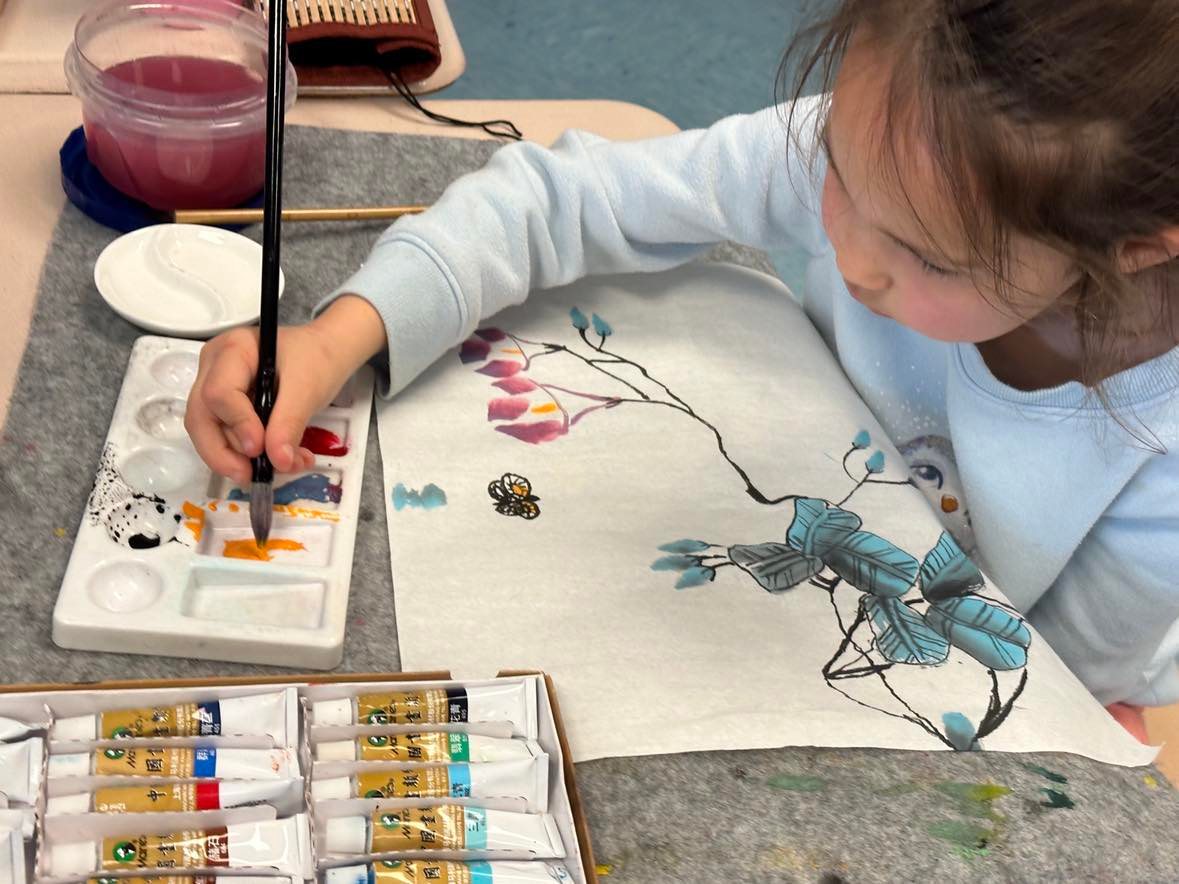
There have been so many sociological shifts from COVID. Among the most fascinating to me is the reversal of the centuries old rural to urban migration. Prior to COVID, more than 80% of the world’s population lived in metropolitan areas. While the reversal has only just begun, it will be interesting to see the residential preferences of people who can remote work and don’t need to crowd into urban areas.
First, let’s put RTO to bed. “Return-to-office died in ‘23,” said Nick Bloom, an economics professor at Stanford University and work-from-home expert. Yes, large companies like Meta and Zoom made headlines by ordering workers back to the office. But, Bloom said, just as many other companies were quietly reducing office attendance to cut costs. https://www.usatoday.com/story/money/2023/12/21/remote-work-from-home-trends-2024/71991203007/
In addition to the fact that it’s cheaper for companies not to pay for office space, heating and cooling, Internet and electricity, remote workers report being happier and workers report they are more interested in remote work than in a raise. https://stackoverflow.blog/2023/11/27/are-remote-workers-more-productive-that-s-the-wrong-question/
The demand pull for remote work is going to put increased pressure on companies looking for talent. Where corporations can, they will be pushed to convert positions to remote work eligible over the coming decade. Some 40% of the current jobs can be done from home. https://www.washingtonpost.com/business/2023/05/23/post-poll-remote-work-hybrid-future/ The COVID surge followed by the slower, but continuing trend for remote positions, will free people up to move away from the metropolitan areas.
Nearly 83 percent of the U.S. population lived in an urban area in 2020, and that number was expected to reach nearly 90 percent by 2050, https://www.statista.com/topics/7313/metropolitan-areas-in-the-us/#:~:text=Nearly%2083%20percent%20of%20the,nearly%2090%20percent%20by%202050.
But wait.
The data showed more residents moved out of the Golden State than into it in 2023, with 58% of California moves being outbound in 2023. California saw its first-ever population decline in 2020 when the state imposed rigid lockdowns during the COVID-19 pandemic. Housing prices are falling in cities like Phoenix, Pittsburg, Salt Lake City, San Francisco, New York City, Austin, Texas and Chicago where people are moving out toward areas with cheaper costs of living. https://www.gobankingrates.com/investing/real-estate/cities-where-home-prices-are-falling-most-this-year/
“Connecticut is gaining a huge bonus from the remote work and the pandemic flight from New York City,” says Dowell Myers, a professor and director of the Population Dynamics Research Group at the University of Southern California.
Some people leaving concentrated areas are moving to traditional retirement states like Arizona and Florida for the year round summer experience. But many are moving to states that aren’t known for their metropolitan centers including North and South Carolina, North Dakota, Montana, Oklahoma and Idaho.
But the service industry still exists. Even though computer programmers, project managers and accountants can do their jobs from anywhere, people working in retail and service industries still have to go to brick and mortar locations. However, the services will have to follow the migrant herds leaving the cities and going to the outback of Montana. So even those jobs will be exiting the populated centers, albeit slowly.
How will all these changes impact the social fabric of our country?
People in cities often ignore each other, but people in the country greet each other. This sociological change may be amplified by the sitting-is-the-new-smoking reality. Remote working office etiquette will change. One possibility is that meetings can be labeled screen visibility required meaning the participants will be best served by sitting at a screen. But more abstract theoretical discussion meetings will be labeled “walk-friendly.” Since remote workers on discussion meetings can and will walk around their neighborhood, we’ll see a renaissance of the local community. We’ll have an increased ability to recognize our neighbors.
The homeschooling trend that started with COVID will continue to increase both because parents are in the house remote working so they can provide security, such as calling 911 if there were an emergency, and because a new industry is growing up around the new demand for homeschooling. Online live or webapp courses will allow elementary, middle and high school students to study what they want, when they want and as long as they can show sufficient progress that parents can focus on remote work, kids will get more autonomy, mastery and purpose.
https://www.washingtonpost.com/education/interactive/2023/homeschooling-growth-data-by-district/
School will become a series of day camps and activities like Singapore Math classes, Mathnasium and Coding camps, focused on interactive and entertaining activities as well as educational activities because the students have a say in what they are being taught and how and they can vote with their feet.
The dictatorship of being involuntarily committed to a particular school district and classroom based on a zip code will be replaced with choice. Consumer choice has been a trend in the U.S. starting in the 1920s as documented in Jason Voiovich’s Booze, Babe and the Little Black Dress, but elementary education has so far managed to escape the conversion of choice. Not any more. The rise of homeschooling and unschooling is doing more than private schools or charter schools ever could.
Backyard vegetable gardens, raising chickens and mason bees have all received a surge as a result of the remote work move. People who are at home and who are migrating to more remote locations with more space have the option of growing their own food. And they are both because it tastes good and because gardening is a great hobby. Homesteading YouTubers are making bank on this new trend with websites like “3 Mississippi” about a family that left San Diego to move to Houston … I mean Houston, MS and 30+ acre farm.
A decade from now, our lives will be simply more enjoyable, more friendly, more pleasant completely independent of any change or increase in income of material wealth.
Do you think I’m overly optimistic?
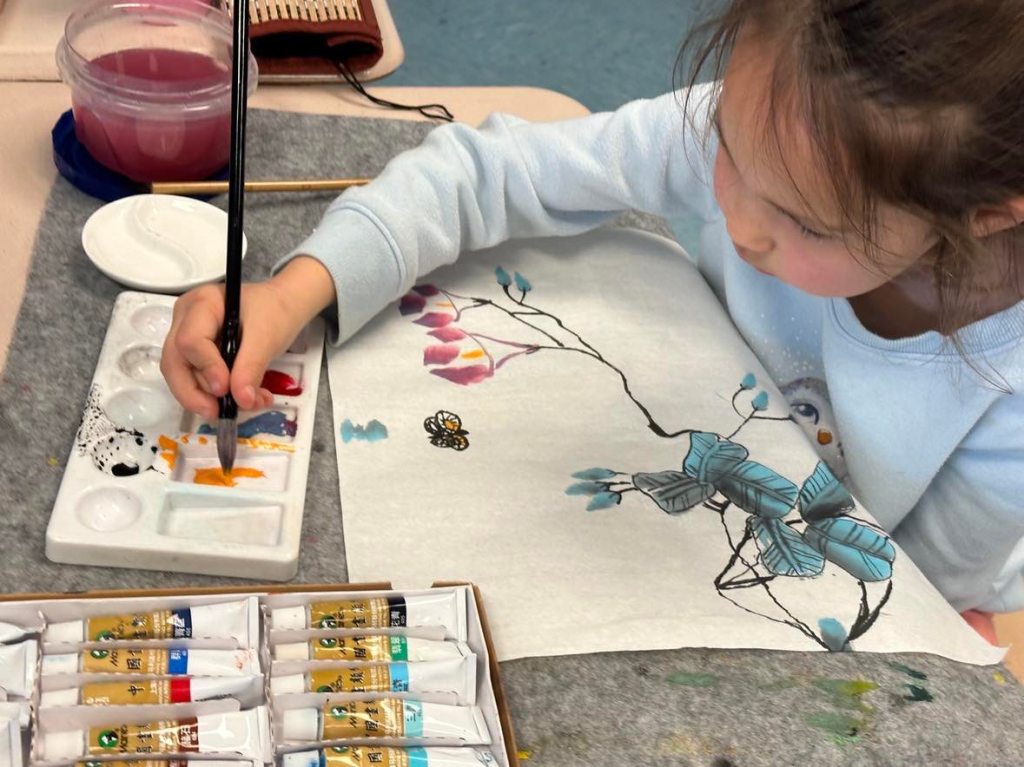
Completely reimagine early education – outside the bell curve
What if we completely reimagined education with a healthy dose of AI? What if a standard classroom of 30 kids were broken into groups of ten that rotated through options like a gym circuit course?
10 kids on computers studying math via AI like AdapatedMind where the algorithm automatically moves up or down according to how many correct answers the kids get and offers videos or hints when there’s clearly some problem in understanding and maybe it triggers teacher attention if someone gets a lot of questions wrong and/or stops answering
10 kids in a room with mats and gymnastics equipment and, of course, supervision.
10 kids at a crafts station.
Then they all move every 20 to 25 minutes until everyone has completed all 3 stations twice.
Then another set of 3 stations including 1 AI reading comprehension, 1 outside on the playground, and one at a science experiments station
Same thing rotate until they all do the stations 2x.
Then another set of 3 stations, 1 includes AI science videos with comprehension questions, another kinetic education option for math like measuring things and a writing station where they journal.
Same thing rotate until they all do the stations 2x.
37% of jobs in the USA could be do via telework
I used to commute to work by bike, metro, MARC, slugging, driving, Uber. Now I’m dreaming of a day when I can slough off commuting forever.

I fought the city of College Park vehemently to get a double wide driveway, which they refused, due to a 20 year old law that said no cars parked in front of homes. Drive ways are only allowed beside homes. The number of cars per person has nearly reached 1 to 1 in some areas of the United States.
https://www.energy.gov/eere/vehicles/fact-617-april-5-2010-changes-vehicles-capita-around-world
My neighborhood is packed so tightly with cars parked in the street that there remains only one lane down the middle. All streets in the Hollywood neighborhood of College Park are effectively one-way both ways.
In our case, we have a tiny little subcompact car I used to get to and from the office daily and a compact SUV we use for shopping or getting our daughter to Patapsco Park or Wheaton Regional Parks, two of our favorite haunts.
Thanks to COVID, I’m wondering if the constant growth of cars per capita might actually reverse itself. In addition to buying more and more cars, we are building more and and more lanes and there’s an extensive metro expansion planned to help move all these bodies into office buildings around the national capital region, but why?
Nearly 40% of the people who are going to work everyday can work from home. That number is almost certainly higher in the DC area. So why not save on the emissions? Why not stop expanding the highways? Why not stop buying so many cars? And running out of places to park them?
If I could be absolutely certain that I would never have to go to my office again, I would likely sell my car. We wouldn’t need to fight with the city about a double wide driveway. We could save on car insurance. And gas. A lot of gas.
Would 37% of American households sell one car? maybe not because many of those households probably have 2 people who can telework, so maybe only 20% of American households would sell their cars.
What would the morning commute look like for those who still have to drive if 20% of the cars disappeared? What would our air quality look like? I’ve been watching my daily report of Good, Good and Good this year. Clean, clear air is NICE!
And what would College Park look like if 20% of the cars didn’t have to be parked in the streets because they no longer existed?
At the beginning of this year, we were talking about which SUV we would buy when replaced the subcompact car. Just 8 months later, I’m thinking of getting rid of it for good. COVID dreaming
https://www.bls.gov/opub/mlr/2020/article/ability-to-work-from-home.htm
Electrical Safety
New electrical options like USB ports on outlets, USB small electrics, LED lights and solar powered items are making our homes safer.
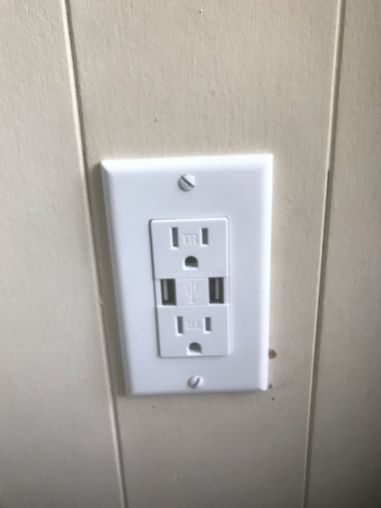
With a 4yo around the house, I worry a lot about electrocution. Classic electrical outlets have a fundamental design flaw in which if anyone or thing were to touch both of the prongs when they were halfway into the outlet, it could go horribly wrong.
Furthermore, when I was working for USACE, DisastersRUs, I did a lot of reading about what goes horribly wrong during floods and other water related disasters like storm surge. As it turns out, good Samaritans who try to help people by slogging around in the waters, can and sometimes do get electrocuted by electrical currents from nearby houses.
And, of course, with traditional electrical home systems, there has been the possibility of home fires due to electrical shorts. Home electrical fires account for an estimated 51,000 fires each year, nearly than 500 deaths, more than 1,400 injuries, and $1.3 billion in property damage. Electrical distribution systems are the third leading cause of home structure fires.
https://www.esfi.org/resource/home-electrical-fires-184#
Electricity is scary. Especially with kids who don’t understand the risks. So as my daughter and I were stringing blinking Christmas lights on the trees, playground toys and fence in the backyard, I was happy the lights were solar powered. With a full days’ sunlight, they are colorful, but by morning, they are dim and if it rains all day, they hardly come on at night. I’m not an electrical engineer, but I assume the 4″ x 4″ solar panel connected to each strand wouldn’t be able to collect enough power to kill me or my daughter.
https://www.bobvila.com/articles/best-string-lights/
One of the advantages to modern Christmas lights is they are usually LED, especially the solar powered version, so , a 100-count string of incandescent mini lights runs at 40 watts, while a 70 count of 5mm Wide Angle LEDs is approximately 4.8 watts total.
https://www.christmaslightsetc.com/pages/how-much-power.htm
Offhand it would seem that a shock of 10,000 volts would be more deadly than 100 volts. But this is not so! Individuals have been electrocuted by appliances using ordinary house currents of 110 volts and by electrical apparatus in industry using as little as 42 volts direct current. The real measure of shock’s intensity lies in the amount of current (amperes) forced though the body, and not the voltage. Any electrical device used on a house wiring circuit can, under certain conditions, transmit a fatal current.
https://www.asc.ohio-state.edu/physics/p616/safety/fatal_current.html
I can’t even find a reference for how much amps in a string of LED Christmas lights but it’s in the range of 3 volts. Literally like nothing. A single lemon produces about 7/10 of a volt of electricity. If you connected two lemons together, you can power an inexpensive digital watch (uses about 1.5 volts). That’s funny, so the solar powered Christmas lights my 4yo was stringing up have about as much electricity as 4 lemons.
http://www.reachoutmichigan.org/funexperiments/agesubject/lessons/energy/lemon.html
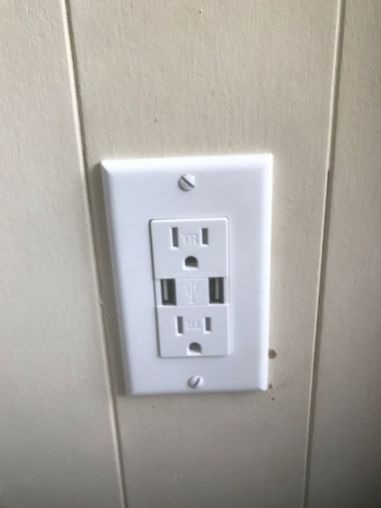
I love these electric outlets and we have had them installed throughout both our houses. They have USB ports on either side of the outlet. We have also installed a couple of outlets that have just a set of 4 USB ports and no classic outlets at all. So many new electrical devices from clocks to smart speakers, children’s night lights and other small electrics are arriving with USB cables that an increasing number of devices don’t need the standard pronged outlet.
What I love about USB ports both in the home and in the car is that I feel pretty comfortable letting my 4yo plug in the cable for her iPad. According to the Apple website, “It is totally safe. A Lightning Cable is like a powered USB. In the worst case (an iPad), it’s 5 V (and 12 W), far from enough for damaging your children.”
https://apple.stackexchange.com/questions/233673/is-the-lightning-connector-safe-for-my-children
I like the new electrical options because I think they are safer for children, safer in floods and less likely to be responsible for home fires. In short, I think in the future, we’ll see less human fatalities related to electricity. I’m hopeful. But what I’d love to see is legislation requiring the safer USB ports in new home construction and requiring small electrical devices to have USB cables if it can sufficiently power them.
PJ Generation
Things that are changing: Rural to Urban Migration
Up to 40% could telework fulltime
More neighborly
More Walking, Fitness, Less Car, Gas & Pollution?
Death of the Office Building
Death of the Dry Cleaners and Business Suits
Increased Productivity, More Energy Focused on Work/Family, Less Driving
Possible Rise in Domestic Violence
Increased Learning Curve for Middle Class Kids
More Home Office, Home Improvement, IOT and More Screen Time
More eCommerce
We had a great opportunity to chat with Dror Shaked of Wix this week and asked him what the future of digital publishing holds. He said his latest public presentation was titled the pajama era. I started thinking what does that really mean across the social spectrum?
Urban to Rural Migration
For a dozen generations or more, the world’s population has been moving from rural to urban. The PJ Generation may reverse that. A new poll shows that nearly 40% of urbanites are considering fleeing the city as the coronavirus pandemic rages on. https://www.millersd.org/news/article/people-are-on-the-move-to-rural-251-415/ In the simple map above lies a stark spatial imbalance: half the people in the world cram into just 1 percent of the Earth’s surface. https://www.businessinsider.com/maps-show-worlds-insane-population-concentration-cities-2016-1
Historically, rural poor move to concentrated areas of population to find better employment. This includes the American farmer and the Chinese factory girls. Even in Egypt, where some 90+ percent of the population lives in that nation’s capital.
One of the many socio-economic elements that the rural to urban migration has had around the world is a shockingly high real estate cost in areas of concentration like Tokyo, Shanghai, London, San Francisco, Vancouver and DC. Obviously, the lure of cheap and spacious housing is attractive, but historically, rural areas with low cost housing had no industrial base, and thus, no substantive income opportunities.
As much as 40% of the workforce could telework fulltime
COVID-19 may yet do what years of advocacy have failed to: Make telework a benefit available to more than a relative handful of U.S. workers. Only 7% of civilian workers in the United States, or roughly 9.8 million of the nation’s approximately 140 million civilian workers, have access to a “flexible workplace” benefit, or telework, according to the 2019 National Compensation Survey (NCS) from the federal Bureau of Labor Statistics. And those workers who have access to it are largely managers, other white-collar professionals and the highly paid. (“Civilian workers” refers to private industry workers and state and local government workers combined.) https://www.pewresearch.org/fact-tank/2020/03/20/before-the-coronavirus-telework-was-an-optional-benefit-mostly-for-the-affluent-few/
However, according to a Bureau of Labor Statistics report, “The authors find that 37 percent of U.S. jobs can be performed entirely at home—a number that greatly exceeds any recent estimate of how many workers telecommute on an average day. According to the 2018 American Time Use Survey, ‘less than a quarter of all full-time workers work from home on an average day, and even those workers typically spend well less than half of their working hours at home.'” https://www.bls.gov/opub/mlr/2020/beyond-bls/the-number-of-people-who-can-telework-is-higher-than-was-estimated.htm
We May See More of Our Neighbors
I’m scratching my brain trying to remember which book I read in grad school talked about the elimination of the neighborhood as a result of women joining the work force. It might have been one of those Bowling Alone dystopian view books. I read Turkle’s Alone Together and wasn’t impressed. I was more impressed by Clay Shirky Here Comes Everybody, Cognitive Surplus and Don Tapscott’s Growing Up Digital because they focused on how technology was remaking our social connections based on passions and shared interests. This seemed more compelling to me than just hanging out with whoever happened to be born in a geographically co-located residence.
But the dystopian authors bemoaned the time lost in face to face interactions. This summer and fall, I’ve seen a LOT of my neighbors. We are all walking circles around the same blocks and hanging out with kids and dogs at the same neighborhood parks. I’m learning names of neighbors and kids and dogs. This is the kind of community that was apparently lost when women joined the work force because the book whose name I can’t recall talked about how housewives used to spend time together watching kids, sharing recipes, pantry items, etc.
So work from home, some 40-ish percent who may also be moving to rural areas for cheaper, more spacious housing could change the national landscape, including house prices and social fabric, allowing for more awareness of neighbor’s names and lives.
More Walking, Fitness, Less Car, Gas & Pollution?
For me and from what I hear, many of my coworkers, often walk around the neighborhood while on teleconference discussions. I do it mainly so I can resist the temptation to read that email that just popped up. I find I remain more deeply engaged in telephonic conversations or Google Meets if I’m not sitting at a computer. And like many of my peers, I’ve become an obedient slave to my smart watch that complains if I sit too long, warns me that I haven’t yet walked as many steps as I had yesterday at this time and I need 30 minutes of elevated heart rate, so I should get moving. Walking around the neighborhood while teleworking means I see and wave at more neighbors, their kids and dogs.
The PJ Generation almost certainly means a sharp reduction in gas use and car mileage, cleaner air and less pollution. It means less cafeteria food. It might even mean a reduction in our nation’s growing waist lines. My iWatch often complained at me while I was driving home from the Pentagon that I’d been stationary for too long, but I couldn’t very well get up and walk around while stuck in beltway traffic.
Death of the Office Building
And corporations and local, state and federal governments don’t need huge buildings. We don’t need all those wider highways.
Death of the Dry Cleaners and Business Suits
Obviously, less suits, which means the decline of the dry cleaner and Ann Taylor, the only real women’s professional suit maker. Yesterday, Bloomberg featured an article: Work from Home Crushes Dry Cleaners. If you want to know the state of the return to office, take a look at U.S. dry cleaners. 1 in 6 have closed or gone bankrupt as more people work in their sweatpants instead of freshly pressed dress slacks.
https://www.bloomberg.com/news/videos/2020-11-25/work-from-home-crushes-u-s-dry-cleaners-video
Of course, Zuckerberg and Bezos had already changed the nation’s social expectations of the dress code for the smartest guys (and gals) in the room. So, Americans go even more casual that we always were. I think this is great. Since I was a kid in a Catholic Church, I hated the pageantry and wealth displayed in our clothes.
So we down-cost our homes and dress down our clothes. Get out and see our neighbors. What else?
Increased Productivity, More Energy Focused on Work/Family, Less Driving
I think the workplace is going to gain a significant boost in productivity. Some reports have already talked about this. Since people aren’t spending an average of an hour each way in traffic, they have more energy to focus on work and home. There has been some discussion about the lack of work/life balance because work never ends, but I find that something like a split shift works well for our household. I hit the computer as soon as I wake up, sometimes as early at 5:30, when had I been driving to the Pentagon, I would have wasted time, showering, suiting up and driving. I work until my daughter takes a break from her teleschool and we do something together – eat lunch, LEGOs, tennis, read a book. Then back to work until she’s finished with school. Another break until she goes to tae kwon do or pony riding class or when she hits the bath. Then just before bed, I hit the computer again.
The previous work day was 8 hours at the office, 1 hour of lunchbreak that I couldn’t share with my family or neighbors and at least an hour each way driving, sometimes more. Even if work infringes a bit outside of the 8 hours required, I should still get more family time. After all, the total work day used to require 12 hours outside the house.
Possible Rise in Domestic Violence
One possibly negative impact of all the PJ Generation is domestic violence. https://www.webmd.com/lung/news/20200818/radiology-study-suggests-horrifying-rise-in-domestic-violence-during-pandemic#1
For kids in healthy families, more time with parents could help increase their learning curves. However, some kids, myself included, saw school as an escape from an uncomfortable home life. We’re already seeing an increase in the income gap as a result of COVID. The PJ Generation might see a greater separation between low and upper middle income which is exasperated by triumvirate of income, mental and physical wellness, and substance abuse. It’s a well know and understood element of life for people struggling with debilitating illnesses like depression and PTSD that “self medication” is often a logical extension of the mental misery. Domestic violence is often related to alcohol or other substance consumption. Additionally, mental and physical illnesses can interfere with a person’s income generating capabilities. As a result the 3 elements interact together in a terrible way to bring people and families down.
One possibility is that people who suffer might be able to find gainful online employment and/or education that they would never have been able to engage in due to their illness. But another possibility is this cohort falls further away from the social fabric.
Increased Learning Curve for Middle Class Kids
For my daughter, she loves having all 3 adults in the house with her – grandma, dad and mom. And it allows us to tag team with her insatiable need for attention that is exhausting for any one person. So, for the middle class, I think kids will benefit from the PJ generation.
More Home Office, Home Improvement, IOT and More Screen Time
More time at home means more IOT. More voice interactive speakers, TVs, lights and thermostats. More smart homes and more home offices. We’ve already seen a sharp uptick in home improvement during COVID. Americans spent over $6B more dollars this year than previously on home improvement at Home Depot alone. https://thehill.com/policy/finance/526305-home-depot-sales-surge-as-americans-spend-on-home-improvement-amid-covid-19
We’ll probably see an increase in screen time. “Zoom meetings. Distance learning. Online shopping. The coronavirus pandemic has caused us to spend more hours than ever facing a screen. While that allows us to carry on many of our daily activities safely, it may also bring with it some concerns.” https://www.rivertowns.net/news/education/6749222-Screen-time-increases-with-pandemic-adjustments
More eCommerce
During the first two quarters of 2020, stores like Ulta, Macy’s and Kohl’s experienced dramatic spikes in their ecommerce revenue, rising roughly 200%, 53% and 60% respectively. The International Council of Shopping Centers predicts a 25% rise in ecommerce sales in 2020. https://insights.digitalmediasolutions.com/news/ecommerce-transactions-rising
Micro-farming could save humanity
My buddy Bassem said, “If the world turned vegan the emissions will be reduced by more than 60% we will save 80% of the water and 70% of the land and we will have less chronic diseases.” But, he admitted, we can’t turn everyone vegan. Still, the problem of large professional meat farming is a major issue.
My brother and his wife on The Crouch Ranch raise and process their own poultry and hogs and, of course, eggs. While some 83% of Americans do not live in apartments and therefore, theoretically could do some form of micro-farming like a backyard chicken coop, most local laws prohibit this.
Bassem agreed that grow what you eat could significantly improve our resource issue with regard to meat. But even for those who want to have a backyard poultry source, we need to push the politicians to agree to the idea.
This kind of micro-farming could address a number of issues in addition to climate change. COVID disrupted food chains. So the first thing I did was go to Home Depot and buy $115 worth of food plants which we have been eating since March. It’s cheaper to grow your own food, cleaner and there’s less doubt that it will arrive at your table. It’s also much tastier.
So write to your local legislators and ask them to allow you to have a backyard chicken coop.

 35-Year Public Affairs & IT Professional