The no-exercise exercise

Coming of age as I did in the Marine Corps, my idea of exercise has always been synonymous with misery. “The more you sweat in peace, the less you bleed in war.” “Pain is weakness leaving the body.”

Among my failed attempts to lose weight since I moved to Washington, DC in the Spring of 2018, I decided to bike to work at the Pentagon in Arlington, VA from Hyattsville, MD. It took one to two hours each way. And when I finally got home to my toddler, I was exhausted and often in pain. The heat was overwhelming in the summer. I did lose some weight, but in the end it came back and I resorted to baggy sweaters and dark colored pants to try to cover the excess me that I didn’t want the world to see.

There’s a Noom quiz about whether running or walking is a more effective weight loss option and the trick answer is, it doesn’t matter. No one could have convinced me of this until I saw it for myself. Not only does torture not help, the Marine Corps’ mandatory 3 miles per day is NOT ENOUGH!!!

I haven’t broken a sweat working out for pretty much all of 2019. Now my “workouts” are strolls. When the weather is lovely, I walk outside my office or home. When the weather is too hot or cold, I walk inside the huge government buildings I work in or on the weekends go to a mall.

Using my wearable, I track the steps. I’ve discovered that I’m actually more successful if I do more short walks than if I commit to a 30- or 40-minute walk. A 10- to 15-minute walk once per hour is actually better since I’m too busy to spend a lot of time on a long walk. Additionally, working constantly on the computer as I do, a break every hour is a nice distraction from a screen-weary mind and screen-bleary eyes.

I actually achieved one mile running in circles in my daughter’s ballet class because the teacher was late and the girls were bored, so when a few of them started running in circles, I joined in to encourage them.

I shoot for 12,000 steps every day. Today I’m at 16,500. But the number of steps isn’t dictated by my weight loss goals, it’s actually dictated by how many steps normally correspond with the highest quality heart rate dip and best deep sleep. After monitoring my activity for a while, I realized that anything less than 12,000 steps and my sleep quality suffers. So, as counter intuitive as all this is, the steps are for sleep quality and not for operating in a caloric deficit.

I’ve been working on adding strength training, but I’ve been adding it the same way I do my endurance, without breaking a sweat or feeling any pain or torture. I have 2 10-pound weights by my desk and 2 at home. They are well within my ability to lift and my hope is to do 5 sets of bicep curls, shoulder presses and tricep presses per day, one set at a time, separated by an hour or more. I also love STEALTH Plankster Core Trainer, but I also use it lightly. Every hour or so, just one minute of planking with the video game. It’s fun, easy and involves no sweat or torture, but I see great gains from light, but constant training as opposed to 30 minutes of hard, intense training that leaves me exhausted.

Another bonus: no crazy logistics of carrying all my fitness clothes and shower gear and adding a shower after I arrive at work on the bike or after 30 minutes in the gym. I love the no-exercise exercise. It has completely upended everything I ever thought about fitness.

I do sometimes jog, but it’s only because I’m short on time and need to get more steps in. It honestly makes no difference how fast or slow I do my 12,000 steps. The deep secret is just move. Slowly, constantly throughout the day and your body and sleep will thank you. You’re quality of life will radically improve and so will your blood work.

It’s literally as easy as a walk in the park.

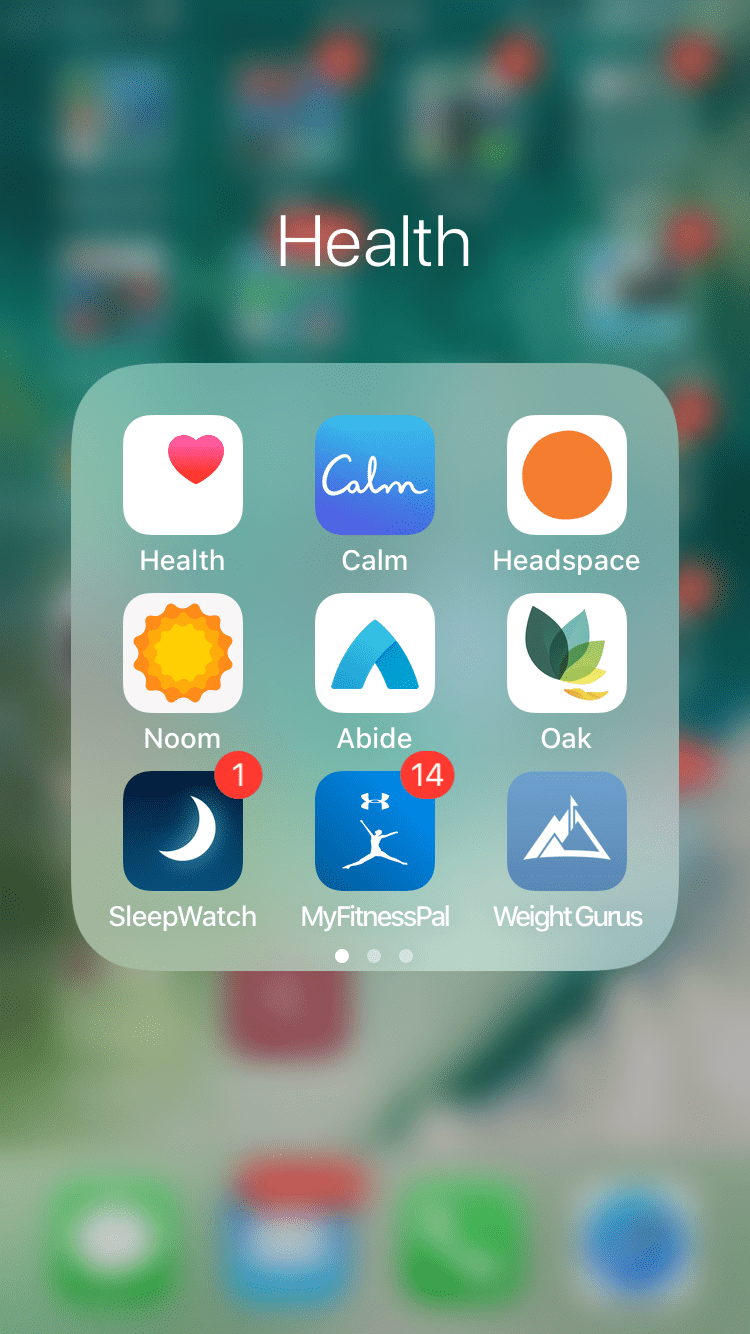
There’s an app for that: Weight loss & technology


It might seem crazy to talk about weight loss by talking first about sleep quality and second about technology, but they really set me up for success.

I have an iPhone with Apple Health app built in, but I don’t think this is the only technology available to provide the services it does. It’s just the one I know. The main function Apple Health serves is that it pulls in data from all the sources into a central location and then allows other apps, with my permission, to access my health data.

What health data?

Well, for starters, every morning after brushing my teeth, I step on my WeightGuru WiFi enabled scale that records my body weight, hydration level, bone density, BMI, and body fat percentage. All this information is then uploaded to the Weight Guru app and shared with Apple Health, which in turn shares the information with Noom. Subsequently, I never actually enter anything into Noom regarding my body weight. It all happens while I’m rubbing my eyes walking off into the shower.

I know have years of weight data ups and downs in the cloud that I can scan back and reflect on. Oh yes! We moved from Texas to DC, lived in hotels there and here, ate fast food. My weight went way up over those few months. And so on.

The previous post talked about how important sleep is
https://charlotteannhu.com/2019/11/16/diet-weight-loss-meditation-sleep/
And the SleepWatch app is a critical element in my ability to understand the impact and effectiveness of all my efforts to improve my sleep quality.

I have used MyFitnessPal for years on and off, but it’s a really wonderful way to track intake. The Noom staff noted that while the calories automatically transfer to Apple Health and Noom, the specific foods consumed do not, so if they are working on coaching eating habits, this automation doesn’t help. I haven’t had problems with my intake and I’ll talk about food specifically in another post, but the MyFitnessPal is critical to understanding what’s coming in and how much it’s worth in terms of calories, carbohydrates, protein, fiber, etc.

I mentioned the value of meditation in the previous post and since I had zero knowledge of meditation, I just use an app for that. I still don’t consider myself to have any understanding of meditation, but I love listening to the content on Calm, Oak, Abide, Headspace. The other night, Calm told me I had listened to their app 500+ times. Wow! I had no idea. I also love Amazon’s Audible and audiobooks. You might like podcasts, but I find that listening with my eyes closed is a great way to relax at night.

Noom exists solely in an app. Unlike other digital support systems like MyFitnessPal and WeightGuru which have corresponding websites, there is no website interface for Noom. It’s only available in an app.

So, get your tech set. Upload all your data into your apps. And even if you have zero plans to eat healthy, once you know exactly what you’re eating and how much you’re moving and how those two balance out, you almost can’t help but start tweaking it.

Early on with MyFitnessPal, I had a crazy urge to eat something delicious. But when I put it in the app, I was shocked how much calories, fat, sugar, etc. Then I considered whether a half of quarter serving of the same dessert might not hit the spot. I ate a fraction of what I was planning on eating and felt really happy with having eaten it. I undoubtedly would have eaten the whole thing if I hadn’t put it in the app first. I tend to do that a lot. I’ll think about eating something and wonder if it’s going to give me sufficient fiber or protein and if the numbers don’t add up like I want, I make another food choice.

That’s another detail. I don’t avoid carbs, fat, calories, etc. I chase protein and fiber. But that’s part of the food discussion, so I’ll cover that next time. For now, just set up your tech. Download all the apps. Tryout some meditation. Start logging food. Give your Apple Health permission to record your exercise, steps, hours standing, etc. Give it permission to share that information with your Noom app.

Buy a WiFi enabled scale. Step on it naked every day just after you wake up. Buy some kind of wearable (watch) that tracks your steps, health, heartrate, sleep quality. I talked about the options in the previous post: iWatch ($300?), FitBit ($140?) and HuaWise ($28).

Sleep & Tech 1st. Worry about food and exercise later.

Happy Health!

What Does 21st Century Literacy Look Like?

I don’t think the traditional text on paper is going to be important once voice user interface (VUI) and smart speakers are everywhere. Currently, we have some 4 billion people connected to the Internet. It will be a while before we get the remaining 3 billion and longer still before they all have VUI access. However, my guess is that will happen before the remaining 20% of the globe who has yet to become literate gains text base literacy.

So if reading letters on paper isn’t the key to economic success and subsequent social ranking (in some cultures), what is the knowledge that is critical in the knowledge economy? Clearly for our tech-based world, computer literacy is a critical element, but millennials all over the world are showing surprising acumen in this area. So, what else?

I personally think numeracy (knowledge of numbers, aka math) is critical. I also think financial literacy is lacking in the US and while interrelated to numeracy is clearly a distinct thought process.

I also think musical literacy is related to math, although as a musical Luddite, I’m not clear in what way. I also think musical literacy is a critical skill. However, beyond some vague notion of how it impacts synaptic growth, I’m not sure why.

What are the other forms of literacy that are important to our lives today and in the next decade or two? Perhaps emotional literacy?

Let’s Talk About Contested Domains

Contrary to what the world thinks about domains, not all domains are URLs.

For the U.S. military, there is a DIME model as described by author R. Hillson on the Naval Research Lab website:

Click to access 09_Simulation_Hillson.pdf

Hillson says: By necessity and doctrine, the projection of “soft power” is becoming increasingly important to the U.S. Department of Defense. The elements of soft power are often abstracted as Diplomatic, Information, Military, and Economic (DIME) actions and
their Political, Military, Economic, Social, Information, and Infrastructure
(PMESII) effects.
Then during the Air Force Association speeches, the Air Force leadership introduced via excellent and simple explanation of what a domain is by using a classic historical reference, 1 if by land, 2 if by sea. Leadership went on to explain that in addition to the standard air, land and sea contested domains in which war has always been fought, we must add cyber and space.
The Deputy Sectary of Defense explained it well and portions of his speech were presented on traditional media outlets:
Let’s start to unpack this a bit. First, there’s nothing “soft power” about either a trade war or actions required when the U.S. department of defense is called into action. I’m a bit surprised by the NRL depiction of soft power. My concept of soft power is manga and anime in Japan and Hollywood for the U.S. DIME and air, land, sea, cyber and space are hard power issues, in my opinion.
Let’s take a closer look at DIME. Diplomacy, Information and Economy are all deeply contested areas. Of course, military is a deeply contested domain, but it covers the previously mentioned air, land, sea, space and cyber. My problem is with economy, diplomacy and information. Not only do I think we fight in these areas, I think we would be well served to develop strategy with a recognition that all of these areas are contested.
Additionally, the world according to Mao per On China by Kissinger indicated that two other areas of critical importance to strength were domestic and global public opinion.
Then, I haven’t yet seen where authors pair critical elements. Military and Economic, for example, are deeply interdependent. A large and powerful military requires a robust coffer to create and maintain.
Moreover, information as a contested space, is deeply related to public opinion, both foreign and domestic.
I’d like to see a new, more comprehensive domain evaluation that looks more like the 8 ways of Buddhism. I think the 8 domains we need to embrace and recognize as contested are air, land, sea, space, cyber, information, economy and public opinion. We need to seriously reexamine our view of domains.

New view on the Thucydides trap

Much discussion about whether the U.S. and China are destined for war ignores classical Chinese strategic texts about playing the barbarians against each other for the benefit of China. The Korean Conflict may be the Chinese greatest accomplishment with regard to the Chinese methodology for waging war. To truly accomplish one’s objectives with the least amount of loss to the home country is the ultimate Chinese military strategic accomplishment. If it’s true that Mao engineered the Korean Conflict, the U.S. and China have been at war since before my mom was born.

What if? Mao manufactured the Korean Conflict?

A close reading of Kissinger’s On China includes solid data regarding the Chinese deception of Moscow. The Chinese Army was already marching south on the peninsula when Mao cabled Moscow to tell them the Chinese would not interfere in the war between North and South Korea. Moscow and Beijing both blame the other for having originated the idea of North Korea invading South Korea.

Kissinger documents Chinese history, philosophy and tactics which include playing the barbarians against each other and using chess-like or Goban-like political moves to diminish an enemy’s national funds, national clout and domestic popularity. Kissinger notes clearly that the real winner in the Korean Conflict was China. At the end of WWII, the two most powerful global forces were Washington, DC and Moscow. At the end of the Korean Conflict, both had lost considerable domestic confidence, national financial reserves, human lives and global confidence.

However, Kissinger stops short of blaming the creation of the Korean Conflict on Mao. If Mao was able to manufacture a global event that cost, by some estimates 3 million lives both civilian and military, it was his crowning achievement as the ultimate political manipulator. It’s hard to imagine from a JudeoChristian ethic that someone could care so little for human lives as to use 3 million people as pawns in a political maneuver. However, in the military strategic view of classic Chinese texts, rather than be a horrific violation of ethics on a near genocidal level, it could be viewed as a master stroke of genius.

Terrifying to think of, really.41gbrddtfll-_sx324_bo1204203200_

Direct Democracy Regulatory Reform

I just wrote this for a university post and I loved it, so I thought I’d share it here.

How I got here

I love democracy. I want to further the cause of democracy by helping illustrate the specific realities of the United States of America, one of the most bodacious democratic experiments in human history. So, I became a government journalist and learned how to put words and photos in a weekly newspaper.

Then I realized that to write anything meaningful for those words and photos in the newspaper, you have to know stuff, a lot of stuff. I promised myself I would take at least one college class per semester, and I have since the early 1980s. I did more than 60 credit hours in search of a bachelor’s degree from more than a dozen different colleges and universities and finally cobbled it all together for a BA in Sociology from Chapman University. Then all but dissertation in the master’s degree from the American University in Cairo (Cultural Anthropology). Then an AAS in computer programming from Cochise Community College. Along the way, I have studied six languages, achieving scores of 3/3 in Spanish, 2/2 in Japanese, 2/2+ in Portuguese and 1+ in Arabic and Korean on the State Department evaluation system, which considers 3/3 equal to a native speaker who has a high school education. I have also studied my husband’s language of Mandarin Chinese.

But I also realized that college isn’t enough. So I read and read and read. I have read dozens of books on national histories, including the history of Chile in Spanish, and Egyptian and Japanese classic works of literature in translation, critical philosophers like Sun Tzu from China and my personal favorite, Plato. I wanted to put the world in context.

Since my earliest days, I’ve tried to find ways to cram more time into a single day or at least more information absorption. Reading a book is slow, cumbersome work. In the early days, when I took home less than a $1000 per month as a enlisted Marine in the 1980s, I would still spend as much as $100 for a book on cassette. I even went to the library to check out books on cassettes or DVDs and listened to them during commutes to work or while waiting for anything – a doctor, an airplane, whatever.

The first time I went overseas, I was limited to two pieces of luggage to sustain me for a year or two. My number one problem was which books to take. I couldn’t take my complete collection of the Encyclopedia Britannica Great Thinkers of the Western World, they were too heavy.

Of course, books on cassettes or DVDs were lighter and if I burned them all onto a hard drive, lighter still. Then one day, I met audible and the iPod classic and my life changed forever.

I could keep a virtually unlimited number of books in my pocket, weighing less than my wallet. I could let the information, including foreign languages, streaming into my ears day and night, even while drifting off to sleep.

Then I saw a presentation with Jeff Bezos talking about the effects of dual modality. That reading the text of a book, something I often did when I wasn’t driving, while simultaneously listening to an audio version of the same book increased comprehension and retention. In a 2016 journal article, authors Rogowsky, Calhoun and Tall explain and explore the value of dual modality. (Rogowsky, Calhoun, & Tall, 2016)

My audiobook collection is just over 800 books, mostly nonfiction, scholarly and history with a smattering of classical literature and science fiction. According to the audible website, I’ve been a member since August 30, 2008. Amazon bought Audible in March 2008, so I’m guessing I was one of the first on the platform. The app on my current iPhone says I’ve listened to audiobooks for a total time equivalent to one month, 14 days, 15 hours and 12 minutes. However, this doesn’t track the fact that I can and do listen to my Amazon audiobooks on my Alexa Smart Speaker, on my government computer using Amazon’s website and from my laptop computer. In fact, I can access my audiobooks from pretty much any internet-based platform, including my daughter’s iPad. I wish the website tracked total reading time across all devices. I listen to audiobooks using my iPhone connected to CarPlay in my SUV but have to use an aux cable in my subcompact car because it doesn’t have CarPlay yet. I called BestBuy and learned they can install CarPlay in my car along with a rearview camera. I plan to get them both installed this winter in addition to buying the Alexa device for autos, one for each car. At that point, it won’t matter if I forgot the cable to connect my iPhone to CarPlay, my car will have a copy of my audiobook downloaded in a device and with WhisperSync technology, it will know where I left off reading on my Kindle or iPhone, so I don’t have to reread the material I’ve already consumed.

Since I’m in the news business, I want to know what’s going in the news, but I want serious news – markets, global events, world political changes, etc., not just the local weather and updates on social media influencers. So I have news apps installed on my cell phone that bring me reports on the Dow Jones, CNN Money, BBC, China Daily, Al Jazeera in English, Fox News, the Washington Post, NPR, CGTN (Chinese government official news channel), Reuters, AF Connect, Asahi Shimbun (the Tokyo daily), and Canberra News. These apps push information to me, scrolling across the screen with the latest in hot news from around the world, often telling the same story from wildly different angles.

According to an article in Political Communication by Zhongdang Pan, all parties, including the news media, politicians and lobbyists work to frame news in a light that best suits their goals. As such, reading diverse content improves topic comprehension and undermines the various authors hope to imprint on me a framing they prefer the public consume. (Pan, 1993)

Where I’m going

When the Air Force hired me as the chief of the public web in 2011, I panicked. I was, in my own assessment, in no way qualified for the job. I was not sufficiently tech savvy. This is why I picked up an AAS in computer programming. I asked my office to pay for a dozen courses in website design, website programming, Microsoft Access programming, and I read all the technology books I could find. Thankfully many if not most of them are available in an audible format.

I started to experiment. I bought programmable thermostats and a programmable vacuum cleaner robot. I bought a smart home security system with an online video camera and smart light switches and smart TVs. And of course, smart speakers. Two. Alexa and Google Home. I wanted to understand the Internet of Things, not just from Forbes articles and the like, although I read those too, but from a lived experience. (Morgan, 2014)

I wanted to understand exactly what the technology was capable of and where it could take us. With a background in sociology, I wanted to understand what would best serve the people and my first love, democracy. I realized voice user interface from smart speakers would smash the centuries-old hierarchy of knowledge that he who reads the most text on paper earns the most money and social clout. I wrote a blog about this idea. (Hu, 2018)

I realized that the extraordinary democratic experience we have had combined with the new crowd sourcing technology could create a reality from the fiction of a direct democracy. (Gardels, 2018) After a job interview with the Alcohol, Tobacco and Tax Bureau, which will most likely be responsible for drafting new regulations regarding recently legalized cannabis, I began developing a concept for an online platform to crowd source the development of government regulations. It is based on an idea cobbled together from Clay Shirky’s books Here Comes Everybody (Shirky, 2008) and Cognitive Surplus (Shirky, 2010). I realized that rather than spending copious hours of time for the limited 480-person staff that runs this remarkably small agency, we could build a website that collects regulation suggestions from the public, allows them to vote them up or down and comment on them. It should be able to allow them to mashup a proposal, meaning copy another citizens proposal and modify it sufficiently that it becomes a different legislative proposal. Then run the finalists through a set of government lawyers to vet them for consistency and publish.

The government agency will significantly reduce its workload. It will completely change the equation of the public comment period. And the remarkably enthusiastic producers and consumers will have a direct say in how their world is governed. Direct democracy has always seemed like a little piece of mythological fiction from ancient Greece at a time when people were in no way equal.

I’m excited by the idea that I might be able to use technology to help my country create a system that allows the general public direct access to policy making. Of course, first, I have to get hired. Still, regardless where I go, I’m always looking for ways to bend the technology to my ambitions, which as one previous supervisor wrote in my annual review, “is more for the organization and humanity than for herself.”

Bibliography

Gardels, N. (2018, October 5). Direct Democracy: Renovating Democracy from the Ground Up. Retrieved from Washington Post: https://www.washingtonpost.com/news/theworldpost/wp/2018/10/05/direct-democracy-2/?utm_term=.0f0049366d52

Hu, C. A. (2018, November 9). New Literacy: Eulogy for Gutenberg. Retrieved from Charlotte Ann Hu: https://charlotteannhu.com/2018/11/09/new-literacy-eulogy-for-gutenberg/

Morgan, J. (2014, May 13). A Simple Explanation of the Internet of Things. Retrieved from Forbes: https://www.forbes.com/sites/jacobmorgan/2014/05/13/simple-explanation-internet-things-that-anyone-can-understand/#206d2edb1d09

Pan, Z. (1993). Framing Analysis:An Approach to News Discourse. Political Communications, 55-75. Retrieved from https://s3.amazonaws.com/academia.edu.documents/45567926/Pan_Kosicki_1993.pdf?AWSAccessKeyId=AKIAIWOWYYGZ2Y53UL3A&Expires=1542319483&Signature=IZRHRLe2lmUemWF2UnoDaUmxzsg%3D&response-content-disposition=inline%3B%20filename%3DFraming_Analysis_An_Approach_

Rogowsky, B. A., Calhoun, B. M., & Tall, P. (2016, September 1). Does Modality Matter? The Effects of Reading, Listening, and Dual Modality on Comprehension. SAGE, 6(3), online. Retrieved November 11, 2018, from https://journals.sagepub.com/doi/full/10.1177/2158244016669550

Shirky, C. (2008). Here Comes Everybody: The Power of Organizing Without Organizations. New York: A Perigee Book/Penguin Group.

Shirky, C. (2010). Cognitive Surplus. New York: A Perigee Book/Penguin Group.
 

New Literacy: Eulogy for Gutenberg

I haven’t yet seen any news reports or research or thought leadership books by techies about the impact of smart speakers on the fundamental structure of our social fabric. I think Alexa is a technical revolution as radical as Gutenberg’s press.

In 1436, Johaness Gutenberg, a German goldsmith, created the printing press. Before then, all texts had to be laboriously copied by hand. Corresponding this critical new technology, born in Eisleben, Germany, in 1483, Martin Luther disrupted religion by translating the Bible and removing control from the hands of the clergy. Since that time, the ability to read text on paper has largely determined economic potential and earning capability in the job market.

Right now, in 2018, there remain some 20% of the world’s population who are illiterate. Others born or who later became blind or severely sight impaired have also been limited in their economic potential due to their inability to access information.

Alexa and other technologies like her, Siri and Google Home, but more importantly, the computing power that has made text to speech and speech to text capability possible will make reading letters on paper altogether irrelevant with regard to accessing information.

I read a book by Microsoft MVP Ben Clothier who explained how to integrate Access and Sharepoint nearly 10 years ago. He seemed at that time to be the only person in the world who knew how to do what we wanted to do with our information. I reached out to him on the web and he said he worked for a consulting firm. I reached out to them and contracted him to help our project. I also contracted two American sign language translators because this brilliant expert was severely hearing impaired and had very limited sight. I offered to pick him up from his home on my way to work, because I learned from a tour at the Lighthouse for the Blind that getting to work every day is one of the biggest challenges in a car culture like ours for sight-impaired professionals.

Centuries or even decades ago, Ben would never have been able to access all the knowledge that put him at the top of his specialty. While limited options were available, like braille, few of the worlds books were available in braille. Because of the digital revolution, information is now available to almost anyone and the final wall is coming down with voice user interface.

At the end of this holiday season, some 50% of American homes will have a smart speaker. Amazon’s website likens it to Star Trek ship communication technology. Ease of use has never been more fluid. No manual required. Even my two-year old can activate Alexa, although she has yet to correctly format a request to get a response. Alexa’s ring turns blue, delighting my toddler when she says, “Alexa.” Amazon just announced Alexa is available in Mexico.

Once this technology is available worldwide and once the world is online, Gutenberg will finally be truly just a note in the history books. The world he created of text will no longer determine one individual’s economic potential by serving as the only path to knowledge and information and ultimately professional expertise.

I have long loved books, and I will miss Gutenberg dearly. Still I can see that Alexa joins the Internet as the most powerful flattening forces of my lifetime.

Learning Languages Liberates our Minds

Give yourself, give a loved one, especially a child the ultimate cosmopolitan gift: Multilingualism.

People who speak two or more languages have significantly better overall cognitive abilities than those who speak one. Learning another language is one of the most effective and practical ways to increase intelligence and keep your mind sharp.  Language study buffers brain against aging. Start today with Creations by Crouch bilingual picture books.

Adele Marie Crouch created her bilingual picture books in the hope to bring the world together and keep unique cultures alive. The German-American grandmother’s children married Italian-American, Mexican-Apache, Nez Perce and Chinese. “Now my grandchildren look like the United Nations,” says the 68-year-old former realtor.

fox_cover_navajoIn retirement, Crouch starting writing picture books. She is deeply committed to providing language training assets in the form of bilingual books, especially for languages which are less available, such as Swahili and Marshallese. She is also deeply concerned with disappearing languages like tribal languages for the Native Americans of North, Central and South America as well as the Pacific islands and African tribal languages.

“One of the problems I’ve had is finding native speakers to provide translations,” she explained. Some languages like tribal languages are difficult to find professional translators for and others may have multiple dialects. This means that people from other dialects complain that the books are not correct. Her books have now been translated into more than 40 different languages.

“I wish I could have learned my family’s language,” says German-American author.

Like so many parents in so many ways, Crouch wanted to give future generations of her family more opportunities than she had herself.

Although Crouch is a German-American, she never learned to speak her family’s language due in part to the reputation that the German nation had earned at the end of World War II. Many German immigrants tried to hide their ancestry and they did this by making sure their children spoke only English. “My grandma didn’t want any of us to speak German,” she explained.

adelemariecrouch
Adele Marie Crouch, author of bilingual picture books in 40+ languages. Photo by Douglas Paul Crouch.


Today, many Asian and Latin American families who have been United States citizens for many generations still speak their family’s language at home. “I wish I could have learned a second language,” Crouch laments. “I wish I could have learned my family’s language. I will make sure my grandchildren and many other people’s children have the option and the opportunity to learn more languages if they want.”

Crouch is also a self-taught artist, working in: Acrylics, Oils, Colored Pencils, Graphite and Charcoal. She has been selling her work for more than 40 years. Her interest in art was inspired by a history lesson which featured Michelangelo when she was nine years old. Her artistic interest became another asset when she started writing bilingual picture books as she illustrated several of her books herself. However, in the beginning she didn’t feel confident enough to illustrate her own books so she hired a professional illustrator, Megan Gibbs. 

Megan illustrated How the Fox Got His Color and Where Hummingbirds Come From.  Within a week of completing the Hummingbird bird, Megan passed away.  Adele was at a loss at first and then decided to try doing her own illustrations and has been doing them ever since.Three of Adele’s relatives, her grandfather and two aunts, were also artists. This helped give her incentive to study and develop her skills in illustration.

Adele sits transfixed for hours just inches away from her easel. Her paint laid out in various tubs and tubes splayed around her. In the quiet room 17 miles down a dirt road, the only sounds are the wind outside and occasional sound of her brush strokes or sighs of happiness or frustration with her painting efforts. Yet, she said she loves her paintings as much as she loves her books and grandchildren.

Crouch’s bilingual language study books include:

  • How the Fox Got His Color is a delightful little story that tells of a young girl’s time with her grandmother as she relates a legend of how a mischievous little white fox with all his grand adventures going over and under and through became the red fox we all know today.
  • Where Hummingbirds Come From continues the grandmother and granddaughter characters as grandmother explains how the magic waters of a bubbling spring spray forth into magical, beautiful birds.
  • The Dance of The Caterpillars is a fun way to teach prepositions. This exciting children’s book contains twenty-two prepositions, one two-word multiple, and two three-word multiples.
  • Alphabet Alliteration puts a twist on learning the English alphabet.
  • The Gnomes of Knot-Hole Manor is a chapter book that focuses on word pairs that have the same pronunciation, but different spellings and meanings.

Crouch has always been fascinated with language and learning, including the structure of the English languages, so her books focus on the unique language elements while weaving them into entertaining stories.

Get started improving your brain today! Buy and read a bilingual book yourself or buy one for your favorite elder or young family member. Language study gives your brain a workout that improves the cognitive abilities of children, increases intelligence, and keep a mind sharp for everyone and buffer the brain against the effects of aging.

Buy Adele Marie Crouch’s bilingual books on Amazon.com or visit her website at www.CreationsByCrouch.com

BilingualBooks-Adele-Crouch.jpg
Bilingual picture books author Adele Marie Crouch at book signing event. Photo by Douglas Paul Crouch.