A former Marine print-photojournalist, former State Department Public Diplomacy Officer, former U.S. Air Force Supervisory Public Affairs Specialist, former USACE Public Web Lead & former Denny's waitress
I’m listening to this amazing audiobook while walking through a shaded forest trail alone. I’m recovering from COVID. My husband and 7yo are playing in the creek. The author, Mo, haltingly describes the loss of his 21yo son, a university student. The story and his tone are heartbreaking.
Then he asks what makes me happy.
This, I thought. Listening to an audiobook while walking in the forest.
Watching the butterflies on the butterfly bush.
Taking photos of my mother in law’s garden.
Listening to my daughter laugh or seeing her smile.
Listening to my husband talk about his job with fascination and pride.
My daughter’s excitement today at finding a box turtle by the edge of the water.
Years ago, I realized that the beautiful thing about the way the Marines teach trust is we don’t actually trust each other so much as we trust our ability to inventory our teammates. What we trust is our own assessment of our peers. Francis Fukuyama wrote a sociological treatise in which he posited that the most successful societies were built on Trust. And the Marines are one of the most successful organizations because of our Trust. It’s just not quite the kind of trust you might imagine.
Years ago, I realized that the beautiful thing about the way the Marines teach trust is we don’t actually trust each other so much as we trust our ability to inventory our teammates. What we trust is our own assessment of our peers. Francis Fukuyama wrote a sociological treatise in which he posited that the most successful societies were built on Trust. And the Marines are one of the most successful organizations because of our Trust. It’s just not quite the kind of trust you might imagine.
I’ll give you an example.
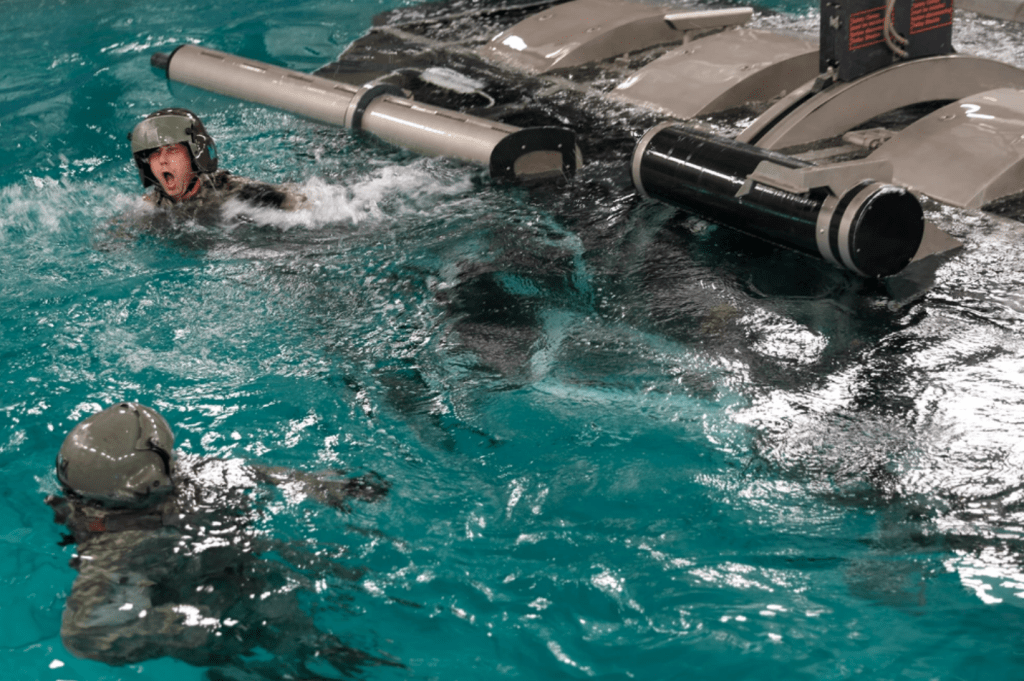
When I joined the Marines, I couldn’t swim. I nearly failed out of boot camp because I couldn’t swim. After passing boot camp with the lowest level possible, I tried repeatedly to get backseat jet qualified. The aviation swim qual is brutal. I failed repeatedly and they had to pull me off the bottom of the pool with that long hooked thing after I started sinking with my aviation gear and boots on. I went through the dunker chamber 4x and on the 3rd try with darkened goggles, I couldn’t find my belt to release it. That’s because I didn’t follow orders. I should have put my hand on the far side of my hip and followed the belt across to get to the release. But being freaked out by being upside down underwater in a tin can, when I didn’t have blackened goggles, I had just looked down and grabbed as fast as I could. Once I had blackened goggles and I couldn’t see the buckle, I freaked out. It took me a few seconds to release the buckle and then I followed the belt and arrived at the buckle but I had exceeded the time the navy divers were allowed to allow us to stay in the can which is counted in seconds.
It felt like someone punched me in the chest. A hand of God grabbed my flight suit and threw me on the surface of the pool beside the ladder going out of the pool. Then I had to go back in again. This time, darkened goggles, but only out the crew door, not just any door.
Later I took advantage of my assignment at MCRD San Diego and went to the pool every week when the recruit depot swim instructors made themselves available to the active duty personnel there to improve our swim skills. I upgraded from Level 4 to WSQ Water Safety Qualified, the highest level before WTI Water Training Instructor. I took and failed the WTI entrance exam repeatedly just like I had taken and failed the backseat jet water qualification.
How could I face my fear of water? Because I knew that water instructor Marines would sooner die than allow a Marine in their charge to die on their watch. That’s not to say one of them wasn’t alcoholic or even in rare circumstances addicted to cocaine. That’s not to say they weren’t the product of a domestic violent upbringing and weren’t practicing what they learned as kids now that they had families. That’s not to say one of them wasn’t sexually abused as a child and inclined to continue the tradition. That’s just to say I had zero doubt they would pull me off the bottom of the pool. I’m not saying all Marines have some substance abuse or other issue. I’m just saying it doesn’t matter with regard to trust. Because we trust each other based on our evaluation of each person’s character and skillset.
Later while serving in the State Department, a colleague complained about me inviting the secret service on our review of the sites we were responsible for during the 1st Lady’s visit to Busan. I responded to her (rather sarcastically) that law enforcement men like them had a higher probability of domestic violence and alcoholism, but I didn’t care if the 2 men beat their wives, kids and dogs when they went home, for the next 2 weeks, they were surgically attached to our hips.
So it was with Marines. They taught me to understand when and why I could and should trust my teammates. Every person I met, I was taught to do a personal inventory. In the Marines, I did it via an initial interview, but my State Department colleagues protested the probing questions about upbringing and hometown, etc., so I began to do it more stealthily, but I never stopped. To this day, I try to take inventory of everyone around me. I want to know each of my colleagues strengths and weaknesses and to rely on their areas of strength and reinforce or redirect tasks that don’t play to their strengths.
There are a few administrative notes. The information in Vee’s chart regarding her sensory issues isn’t accurate. All 5 senses including sight are impacted. She experiences light sensitivity and we have an optometrist appointment this week to work on getting her sunglasses that fit, feel comfortable and can help with the light sensitivity.
We have also gone shopping for clothes in brick and mortar stores where she can physically feel the fabric and try on clothes before buying and we went shopping in a brick and mortar store for shampoo, conditioner, hand soap and body soap so she can smell them before buying.
Top priorities are sleep and her stomach. We’ll continue to give her Miralax daily, possibly indefinitely, to keep the chronic constipation at bay. We might need to evaluate for acid reflux. We might need to medicate for anxiety.
The book Navigating Autism lists the numerous blockers to sleep for Autistic kids/people.
Here’s an excerpt from Navigating Autism:
Symptoms of autism, such as reduced sensitivity to the sleep-wake circadian system, perseverative thoughts or behaviors, anxiety, and environmental hypersensitivity can all make sleep problems more likely. Sensory discomforts such as being aversive to the texture of the sheets (or pajamas), hearing traffic that others don’t notice, or being bothered by a streetlight, can be particularly interfering for a child with autism.
Other physical or psychiatric distress can also lead to sleep disturbance. A child with unrecognized pain or gastric distress is unlikely to sleep well. A hyperactive or anxious child may find it difficult to get to sleep. A depressed child who is experiencing ruminative thoughts will likely have delayed sleep onset as well.
Remembering how sleep disorders can cause a cascade of effects and how they have a bidirectional relationship with other comorbid conditions is critical to the mindset of viewing the whole child. Professionals and parents who keep this in mind will be more likely to spot signs that a child is not sleeping well and will be more apt to gather data on the possible consequences of that disturbance.
What if we completely reimagined education with a healthy dose of AI? What if a standard classroom of 30 kids were broken into groups of ten that rotated through options like a gym circuit course?
10 kids on computers studying math via AI like AdapatedMind where the algorithm automatically moves up or down according to how many correct answers the kids get and offers videos or hints when there’s clearly some problem in understanding and maybe it triggers teacher attention if someone gets a lot of questions wrong and/or stops answering
10 kids in a room with mats and gymnastics equipment and, of course, supervision.
10 kids at a crafts station.
Then they all move every 20 to 25 minutes until everyone has completed all 3 stations twice.
Then another set of 3 stations including 1 AI reading comprehension, 1 outside on the playground, and one at a science experiments station
Same thing rotate until they all do the stations 2x.
Then another set of 3 stations, 1 includes AI science videos with comprehension questions, another kinetic education option for math like measuring things and a writing station where they journal.
Same thing rotate until they all do the stations 2x.
Of all the basic information a parent needs most is to hear this: Your child is capable of loving you. If they do not show affection the way other children do, it is not personal. Parents will learn over time to recognize how their child expresses their connection to the parent.
Atypical sensory experiences are estimated to occur in as many as 90% of autistic individuals. They impact every sensory modality including taste, touch, hearing, smell, vision, proprioception, and balance.
Proprioception, or kinesthesia, is the sense that lets us perceive the location, movement, and action of parts of the body. It encompasses a complex of sensations, including perception of joint position and movement, muscle force, and effort.
Some children with autism cannot distinguish between foreground and background information. Pain and distress may just blend into a chaotic mix of sensations. Other autistic children may experience fragmented perception – the inability to take in multiple pieces of information at once. Instead, they experience the world in bits that do not fit together into recognizable patterns.
Other children may have what is called sensory agnosia. These individuals fail to recognize incoming sensory data, yet their primary sensory functions are intact, and they have no general mental impairment.
In some children, the ability to accurately recognize, process and report incoming sensory stimuli can vary dramatically from day to day. Imagine a child that has a urinary tract infection. Over the course of a week, she may one day not feel any sensation, while another day, mild duress and yet another wailing in pain. This can make it nearly impossible to get accurate medical care for conditions unrelated to autism.
Children may also experience sensory synesthesia, which is a cross channeling of incoming data. This is when sensory input – such as a sound – gets process as or alongside another sense such as color. The child may for example, see the color red whenever they hear a certain musical tone. #autism
As I continue to contemplate the meaning of my daughter’s autism diagnosis, I’m thinking a lot about the Goldilocks Zone of our 5 senses. Just like the Goldilocks and the Three Bears reference we use when searching the cosmos for planets that can sustain life because they are neither too hot nor too cold, we all have a Goldilocks Zone for each of our own 5 senses. The difference for my daughter is that her Goldilocks Zones for her 5 senses are different from mine.
While she is more sensitive to sound, her Goldilocks sound Zone shifts according to the environment and her level of excitement or boredom. I suppose this is true for all of us. In a perfectly quiet room at night in a house in the country, the sound of the flushing of a toilet in another part of the house can wake us. Yet, in a Led Zeplin live concert, we might revel in the cacophony. So too, my daughter covered her ears when the Kennedy Krieger Institute doctor allowed her to look something up on his computer on YouTube, but she doesn’t have any problem with Dave & Buster’s, a particularly noisy place to play lots of different video games and carnival-like games. We have a decibel tracker display in our dining room which we have had for a year or more. While my daughter is calm and happy at 40 decibels and generally doesn’t like more than 70 or so, she can rock the decibel display with her shrieks of enthusiasm at more than 100 decibels. This is the Konnon Digital Noise Meter Wall Mounted Sound Level display. https://www.amazon.com/gp/product/B07XB14FSC
So too do we all have a Goldilocks Zone for scent and taste, which we think of as distinct senses but are actually linked neurologically. While we all have specific tastes and smells we enjoy and those that we don’t, many people with autism seem to have a tighter set of boundaries for their Goldilocks Zone of scent and taste. What’s more, the scent and taste is also connected to the texture and presentation of the food, which, again, it is for all of us and yet the specific Goldilocks Zone is different, perhaps more narrow for many people with autism. Lastly, the stomach pain which I still don’t understand certain contributes, even if only psychologically, to the consideration of food.
While we still don’t know why my daughter’s stomach is randomly angry, many people with autism report GI issues. However, taste aversion is a negative association with food you ate just before you got sick. This is a survival mechanism to make sure we don’t eat something again that might have been toxic. However, if one’s stomach is randomly angry, I can imagine how this natural system could over time pile up a long list of foods that a person develops aversions to, narrowing the options for a satisfying meal.
Sunshine on my shoulders makes me happy. Sunshine in my eyes can make me cry. – John Denver. Obviously, no one likes to drive directly into the setting or rising sun, but light sensitivity is generally reserved for blue eyed, autistic or people taking certain types of medications. Oh, and vampires, of course. We’ve tried over and over to get my daughter to wear sunglasses as she repeatedly complains about the brightness of the world. I’m going to try again by getting her an appointment with an optometrist. The problem is that while she hates the light, she also hates the feeling of anything on her face. I’m amazed that she has finally adjusted to wearing goggles when she swims. Although that was similar to this problem in that she hated both the feeling of the goggles on her face and the sting of the chlorinated water in her eyes. Don’t we all? She was finally able to make friends with the lesser of those evils.
I’ve alluded to the Goldilocks Zone of touch in many of the previous senses, but touch is a challenge because food touches our mouths, sound vibrations as we speak or listen touch our inner ear, nose and throats, clothes touch our bodies and our bodies touch furniture. Hair touches the edges of our faces. Touch is everywhere and in everything. And touch is related to the Goldilocks Zone of boredom or sensation. In her book Unmasking Autism, Dr. Devon Price talks about opting out of many standard social customs like ties for men and other restrictive clothing requirements.
After the Kennedy Krieger Institute psychiatrist gave me our daughter’s autism diagnosis, I listened to the Dr. Devon audiobook and we went shopping for clothes. I had complained to a friend a year earlier that I’d never been able to find a pair of pajamas that suited my daughter’s requirements, but to my amazement we found a pair. I always shop online. I hate to go brick and mortar stores. But as we walked through Walmart, Target and Kohls, Vee put every piece of fabric to her cheek. The ones that felt good to her, she rolled herself into them. I have been looking for PJs for years based on whether they had specific Disney themes or colors she liked. I never thought twice about the feel of the fabric. But the feel of the fabric is her #1 consideration. As she described it, “fabric is first, color is second and style is third.” So, for the 1st time since infancy, she’s wearing pajamas!!!
My impression is that clothing and the Google Ball at her desk and the faux fur washable rug under her feet under her homeschooling desk actually address two different Goldilocks Zones. One is touch. But the other is boredom or being sufficiently stimulated.
Four months ago, when Vee was diagnosed as ADHD, our pediatrician recommended Vyvanse, a stimulant. This made no sense to me. You take a kid who is already bouncing off the walls and give them a stimulant? Dr. Swinton chuckled. First he said we don’t actually know why it works. Then he added it might be they need more stimulation. I think this last part is accurate. There’s much in the literature that ADHD kids/people have zero tolerance for boredom. And again, like the Goldilocks Zones of our 5 senses, who likes to be bored? The difference here is in the degree. Boredom for ADHD kids is a form of torture. And so stimulation that helps to keep my daughter in her Goldilocks Zone, both in the form of medication like Vyvanse and faux clothes, rugs, a bouncy Google ball and most importantly, http://www.AdaptedMind.com webapp for education is critical.
Artificial Intelligence (AI) is coming to public education. Just ask Henry Kissinger. But for ADHD kids, it’s not coming fast enough. Every kid wants to be in the perfect sweet spot, the Goldilocks Zone of education on every topic. And it’s impossible for a teacher to be able to give this kind of educational material to a room full of 30 kids. But AI can. My daughter’s constant mantra regarding public and private education was that it was boring. However, AdaptedMind webapp has constantly kept her almost exactly in her intellectual Goldilocks Zone for mental simulation. She actually likes to learn. She just can’t sit still or keep her hands still (no flapping. Not that flapping is bad. It’s just not something she does at the moment.). She can’t keep her hands to herself and off other students. She can’t listen politely to peers and adults. Anyone with ADHD or a family member completely understands all these elements. This is why AI is so critical. After Vee has answered 5 consecutive questions correctly in math, she’s automatically moved on to a different question type. If she gets something wrong the next day, she’s automatically moved back to a simple topic. AI education is everything education should be. And, of course, edutainment – games that teach.
As long as my daughter is perfectly engaged in her education and perfectly clothed and perfectly fed, her mood is better and we don’t have tug of wars and she doesn’t have meltdowns. At the moment, it seems like we need to nail down her Goldilocks Zones – all of them – and stay inside them. Or, if like a Marine in cold weather training, we are going to venture outside them, we need enough warm gear to keep our bodies and minds in the Goldilocks Zone while we venture into the artic.
My daughter has long seemed to me like she has bionic senses. But unlike The $6M Man in the 1970s SciFi, all 5 of my daughter’s senses are bionic. I’ll give a few examples.
My daughter often focuses on the background soundtrack in a movie or a videogame or the squeaking “music” of the chains a playground swing. She often becomes frustrated with me when she attempts to engage me conversation about the sound that has never broken into my conscious thought. As I try to follow her conversation, my mind is searching for the sensory input she’s referring to and often after she describes it to me 2 or 3 times, I often find I CAN hear it. I hold her in awe for her ability to capture the world around us with such an attention to detail.
I have long since realized my daughter experiences our world in a manner very different from the why I experience it. I always thought this was simply because we are different people and we have different view points. But last week when the Kennedy Krieger Institute doctor told me my daughter is autistic and after reading Dr. Devon Price’s Unmasking Autism and watching YouTube videos by The Autism Dad, I’ve been trying to reconsider what I know about my daughter.
In grad school at the American University in Cairo, I learned participant observation for field work in sociology and cultural anthropology. The idea behind participant observation is to try to literally walk in the shoes of other people. For example, I did my field research at Nedy Masri, the Egyptian Rowing club on the Nile. I rowed, coached and competed with the club. I spent 4 or more hours per day living the life of a rower in Egypt, including the sublime and marvelous moment of sitting on the dock waiting for the sun to rise for practice to begin. The idea of participant observation is to try to understand people often very different from ourselves. There was one of the great thinkers I read during this period of my life who said something to the effect that he’d never met someone that he couldn’t understand at least a little and he’d never met anyone himself included that he could completely understand.
I have long realized I’m a participant observer in my daughter’s life. I’m not particularly interested in music, but it moves through her like an electric volt. When she was maybe 12 months old, I tried taking her to a drumming circle. The 1st 2 times, she jolted and cried as the door opened. We left immediately. But every 30 days, I went back and tried again and on the 3rd attempt, she didn’t cry. Her eyes were wide with wonder and she tapped on a drum. I kept going back because I had watched her interact with things at playgrounds and in toy stores.
1st ever drum circle at 20 months old
The drum circle was in San Antonio and we moved to the National Capital Region when our daughter was 2. She started piano at Ottley’s School of Music when she was about 2 1/2. She was fascinated by her portable electric keyboard. Not just the standard instruction Ms. Ottley provided, but she also walked on it, stomped on it and played with it. Her full sized piano today, remains a toy as well as an instrument. She set herself to record a video rendition of all of the Music for Little Mozarts songs and during one of those recordings, she had an epiphone about what the word staccato means.
An epiphone about the meaning of the word staccato
I simply can’t bridge the gap between the way I process music in my mind and how my daughter relates to it. It’s as if I were to try to compare myself to Phelps in swimming or Baryshnikov in dancing. I do swim and I enjoy it. I do dance and I enjoy it. I listen to music and I enjoy it. But my daughter and I occupy parallel universes when it comes to sound.
Sound isn’t the only area where we are widely different. Vee is super aware of smell and taste. My husband is as well although he doesn’t have a diagnosis of autism. For food, I’m happy with a Powerbar. But from my view both my husband and daughter are unusually picky about foods. Of course, they don’t think it’s picky at all. My husband complains that much that passes for food in the USA isn’t even edible. I will never forget soon after he arrived in the USA and we were staying with my parents in Arizona while I was preparing for Army reserve full time training, he asked me for vinegar. I rummaged in the cupboard of my mom’s kitchen and produced a bottle of white vinegar. His expressed looked shocked. “We use that for cleaning,” he responded. He stopped short of asking me if I would actually consume it.
My daughter often comments on smells and flavors that I’m completely unaware of. My husband noted that Mexican tortillas have a sour flavor. I’d never noticed. Friends have since agreed emphatically. But Bin noted that flat breads from China or India don’t have the same note of sour that is common to tortillas. It might be there, but I never noticed it. In fact, there’s a lot of this when I compare my senses to my daughters.
It seems as if she’s genuinely bionic. Nothing gets passed her senses. And once she observes something from her senses, she then processes for a long time, considering it on an intellectual level. Intellectual may seem like a strong word for a 7-year-old, but it’s not like she’s developing a string theory, she’s simply trying to put it into context with everything else she knows.
This makes me think about echolalia. Recently I was trying to make my daughter more aware of how often her electronics needed charging. I grabbed her headphones and I asked her how much power they had. She didn’t know. I asked if I could show her on her iPhone how to find out. I swiped right and showed her 2 green circles and 1 red blip. I noted that the iWatch was on minimum and the headsets had maximum power. She then repeated minimum on maximum 6 or 7 times. What it echolalia? I had the impression, she was feeling the sound of the repeated “m” sound on her lips and in the sound echoing chambers of the internal ear, nose and throat, in the sinus area. In short, it seemed like mindfulness. As if she took a break for a few moments to mindfully feel and sense and explore the physical sensations created by replicating these sounds.
So later when I wasn’t with her, I tried it myself. It does feel unusually unique. Again, the sounds of maximum and minimum have always been around, but I’ve never really thought about them. I’ve never stopped to lull over them.
Dr. Devon Price mentions a few details in her Unmasking Autism book. One of them is that autistic people need more sleep than neurotypical. Is that because my daughter’s brain is using so much energy to process so much information? Is it because she’s still processing some of that information while she’s sleeping? Do I sleep less because I’m not using my brain to process so much information? Since reading the book Why We Sleep, I’ve been religious about sleep hygiene and never wake my daughter until she wakes naturally. We keep the room dark and quiet, have a calming period before sleep, try to sleep at the same time everyday, etc.
This also makes me think about why it’s so hard to keep my daughter on a schedule. Three weeks ago, before we got the diagnosis from KKI, we opted out of public schools. I did this because my daughter had so many complaints about school – it’s too boring, the bus is too loud, the cafeteria is too loud, etc. The school also had challenges with her. In Kindergarten she called her classmates, “stupid,” and of course, she had problems constantly moving and talking and getting her writing assignments completed, etc.
After we started homeschooling, I was more flexible with her schedule. For example, I asked her to play 3 super simple piano pieces to prepare for Music Guild judge in 8 weeks. I expected this task could take about 2 minutes. My daughter was displeased with the sound of the 3rd and most complicated piece. She played it over and over and over and spent a good 2o to 30 minutes on piano that day. But in homeschooling, I’m not trying to keep 30 kids on a schedule. I’m trying to get 1 kid though 6 topics – reading, writing, math, music/art, science/physiology and social studies. So we don’t have to move like an assembly line.
But maybe the reason it’s hard for her to stay on a schedule is because she suddenly realizes something such as the fact that minimum and maximum have unique physical sensations when pronounced together. And maybe she wants to spend a few minutes exploring and contemplating those sensations and sounds.
Most importantly, I have working theory that the worst meltdowns, panic attacks and even violence my daughter previously expressed was related to masking. Maybe she was trying so hard to ignore her own natural rhythms and march Nazi-like along with the crowd that it was exhausting and degrading her energy, patience and abilities. In the last 3 weeks of homeschooling, her mood has improved and the number of stressful, combative exchanges between us has radically declined. What’s more, she tends to drive her own education. She’s fascinated by knowledge and ideas, and tends to move forward without much push from me. She does occassionally feel intimidated by new concepts and I help walk her into them. But once she grabs on, I let go and she’ follows them through using often very specific ideas of her own.
Last week, the AdaptedMind webapp introduced her to the terms acute, obtuse and right angles. She cut out a 1″ square piece of white paper and went around the living room comparing every angle to determine if the windows corners with right, acute or obtuse or the prongs holding coats on the coatrack by the door or the angles of the wall mounted document organizer. When she finished her inventory of angles in the living room, she returned to the computer and completed the math questions easily. But I can’t imagine letting kids in a classroom randomly run off script. It would be chaos.
Dr. Devon Price talks about the special interests autistic people develop. And she says it’s one of the most important things is to let the passion flow. We have long supported our daughter’s special interests like clay sculpting, drawing, painting, LEGOs, nano blocks, music and others.
Our daughter loves painting
The 1st day she took home her rental violin, our daughter sawed on it for 6 continuous hours. She isn’t interested in violin any longer, but she took 2 semesters of it when she was 3.
We’re still working on how to adjust our lives to better achieve an authentic and happy life, as Dr. Devon Price encourages everyone to do.
How Children Learn by John Caldwell Holt NOTES: #1 classic for all parents and coaches or teachers or anyone involved with kids.
Differently Wired: Raising an Exceptional Child in a Conventional World by Deborah Reber NOTES: Simply fantastic! A must read for anyone whose kid falls outside the bell curve.
The Whole-Brain Child: 12 Revolutionary Strategies to Nurture Your Child’s Developing Mind by Daniel J. Siegel and Tina Payne Bryson NOTES: Fantasic insights into the physiology and physical brain details of people and kids
Raising a Highly Emotional Child: A Mindful Guide to Help Your Child Regulate Emotional Outbursts by Jacob Dittrich
I’m Bored! What’s Next? Understanding Childhood ADHD by Eric Unruh et al.
A Child’s Brain: Understanding How the Brain Works, Develops, and Changes During the Critical Stages of Childhood by Robert Sylwester
No-Drama Discipline: The Whole-Brain Way to Calm the Chaos and Nurture your Child’s Developing Mind by Daniel J. Siegel and Tina Payne Bryson
The Power of Showing Up: How Parental Presence Shapes Who our Kids Become and How Their Brains Get Wired by Daniel J. Siegel and Tina Payne Bryson
The Yes Brain: How to Cultivate Courage, Curiosity, and Resilience in Your Child by Daniel J. Siegel and Tina Payne Bryson
Parenting ADHD Now!: Easy Intervention Strategies to Empower Kids with ADHD by Elaine Taylor-Klaus and Diane Dempster
What Your ADHD Child Wishes You Knew: Working Together to Empower Kids for Success in School and Life by Sharon Saline NOTES: The rage to master – kids with ADHD may become hyper-focused on perfection and meltdown when they are unable to meet their expectations.
The Highly Sensitive Child: Helping our Children Thrive When the World Overwhelms Them by Elaine Aron
Parenting the Highly Sensitive Child: Effective Strategies to Unlock the Full Potential of Your Child’s Gift and Thrive in an Overwhelming World by Elena Jinkins
This book is a fascinating discussion about fat as an organ and a part of the endocrine system. It talks about how the body automatically tries to maintain whatever body weight we have which is why we yo-yo so much when dieting and why our bodies reset after a significant event like pregnancy or a long-term event like a broken limb that reduces our mobility.
Once we understand that our bodies’ shapes are actually a complex set of interactions and not simply a mathematical equation of calories in and exercise out, we can better understand that other physiological needs like sleep are critical components. The lack of sleep upsets a whole series of body chemicals. One of them reduces sensation, that is doesn’t allow us to turn off eating. Another sets us in the munchies mode urging us to eat more sugary and/or salty foods. There are more details, but the end result is if you want your body to balance, #1 priority is SLEEP.
Understanding that the complex chemistry of our bodies determines not only how we look, but also our energy level, moods, concentration, sleep quality, etc., we can take a closer look at insulin which comes into our bodies via simple sugars. This book illustrates the science behind the importance of complex carbohydrates and a diet rich in fiber and protein.
This book illustrates our much of our habits are shaped by lobbies. Our brains dump a chemical into our bodies as we wake, so the old addage that breakfast is the most important meal of the day simply isn’t true. In fact, if you simply eat when you’re hungry, you’ll likely not eat until 9 or 10 AM if you wake up at 6 or 7 and that’s exactly what my 6yo does. Yes, you haven’t eaten for 8+ hours, but your body is fine. You don’t need breakfast and you certainly don’t need what we normally eat for breakfast – sugary simple carbs – sugary, high fructose corn syrup breakfast cereals, pastries and danishes, etc.
It’s wonderful that the summer is over and Vee is officially in 1st grade. During the summer, Vee went to Springfield for 5 weeks of immersion Spanish with Langokids. While there, we stayed with Vee’s friend J, went camping, watched the Independence Day fireworks, swam in the Atlantic waterpark in Bull Run Regional Park, and most importantly chased fireflies.
After Virginia, we drove to LaSalle, Canada where Vee met her uncle and aunts for the first time. After we returned home to Maryland for 3 weeks of STEM camp at Oakdale Recreation Center in Urbana, MD, we went back to Canada. This time to Mississauga, a suburb of Toronto for a week of Happy Mandarin Chinese reading day camp. While there, we visited the Egyptian Museum which has a special display of King Tut’s tomb. We also went kayaking for 3 days and on the 3rd day, Vee went solo!
National Aquarium in Baltimore
National Aquarium in Canada
Vee did 5 weeks of immersion Spanish at Lango Kids in Springfield and while there went swimming with her friends J and Xiang and went camping, including roasting hotdogs and catching fireflies.
Sky zone with Lango kids
Swimming at Atlantis Waterpark in Bull Run Regional Park, Virginia
Watching Independence Day fireworks in Manassas, Virginia
Vee meets her uncle and aunts in Windsor, Canada
Vee visits the Egyptian museum in Mississauga, Canada, a suburb of Toronto
Vee went kayaking on a lagoon fed by Lake Ontario three times and on the 3rd day, she went solo.
Visiting the national aquarium of Canada in Toronto
Over the summer, Vee started learning Japanese kana letters so she could read the names of her favorite snacks from the Asian markets.
Vee hit the Rattlewood driving range before school on her first day


 35-Year Public Affairs & IT Professional