Why AFPIMS?

Why publish an official website on AFPIMS?

All official government public websites should be hosted on AFPIMS because it provides automatic legal and regulatory compliance, world class security, and it’s remarkably simple to use. AFPIMS, which stands for American Forces Public Information Management System is a website content management and website hosting service open to all DOD entities. Some examples of AFPIMS websites are http://www.Defense.gov, the website for the Office of the Secretary of Defense; http://www.ndu.edu, the website for the National Defense University and http://www.af.mil the main official website of the U.S. Air Force. Navy, Marines and Coast Guard main websites are also on AFPIMS. AFPIMS is built on an open source Dot Net Nuke kernel and compiles more than a dozen contracts to add a suite of capabilities from Akamai cloud servers to Granicus email list serve functions. Together this suite of technologies offers one-stop shopping for USAF organizations that need a public website.

AFPIMS provides automatic compliance with a host of laws and regulations in addition to world class security against hackers. A host of U.S. laws govern communications between government agencies and the public. Failure to comply with these laws can result in lawsuits against government agencies. The most common lawsuit against government agencies regarding public websites in recent years relates to the Rehabilitation Act, Section 508 detailing requirements for accessibility for people with sight and hearing disabilities. Interestingly, a significant number of those lawsuits were initiated by the Department of Justice. Another government watchdog, the Government Accountability Office routinely cites legal failures of government agencies, as in this 2015 finding, “EPA engaged in covert propaganda when the agency did not identify EPA’s role as the creator of the Thunderclap message to the target audience.” Finally, a surprising number of official U.S. government websites have been hacked or defaced by adversaries. Most website managers want to focus on content and with AFPIMS, the risks of running afoul of compliance or security issues is minimized.

AFPIMS is so simple, anyone can post content after a couple hours of online training, so no web design programmers are necessary. AFPIMS is a template-based system similar to WordPress or other standard blogging websites. Users choose a template, like news, add a headline, body, tags and categories, bylines and submit. When Air University migrated to AFPIMS, the program manager was pleasantly surprised explaining that many of the people posting content were brilliant, often with PhD-level education, but they were not IT professionals. The AFPIMS and Air Force Public Affairs Agency from Texas sent instructors to Air University and personally training 100+ website contributors. Most offices have limited budgets and even more limited manpower, so hiring specialized staff solely to run a website or web page isn’t realistic. AFPIMS allows average employees to contribute directly to the website.

Some people prefer complete freedom from any templates. Certain organizations have opined they want complete freedom to design websites, and it is true, AFPIMS doesn’t offer complete freedom. However, most consider burden of legal and regulatory compliance, security and specialized employees onerous. Some organizations have tried to manage websites without addressing all these issues. Years ago, a pair of websites hosted on a dusty server in the corner of one U.S. Air Force unit were defaced and the resulted in an OSI investigation and a White House situation room briefing. Another constant risk is a violation of trademark or copyright laws. In all cases, getting a public affairs office to clear content for public release is critical. It is possible to ignore the rules of official government public websites, but it’s not career enhancing.

When considering all the pros and cons, hosting an official government website on the established DOD solution, which already hosts nearly 1,000 DOD websites is the best option available to program managers and commanders. Once a reasonable risk analysis, business case and budget are considered, AFPIMS is almost always the preferred course of action. Even if a unit decides to choose an alternate website hosting service, in all cases, they should engage the local Public Affairs Officer to ensure all publicly accessible content is properly cleared for release. AFPIMS website hosting service offers easy, one-stop shopping to ensure a properly compliant and secure official public website.

Concluding that humans need less than 7 hours of sleep is a tabloid myth

A short section from a book that changed my priorities and my life. Nothing is more important than high quality sleep!
De-mythifying sleep: Concluding that humans, modern-living or pre-industrial, need less than 7 hours of sleep is a tabloid myth.
“sleep study on modern day hunter-gatherers dispels notion that we’re wired to need 8 hours a day”
First, when you read the research paper, you learn that the tribes people actually give themselves a 7 to 8.5 hour sleep opportunity each day with an estimated range of 6 to 7.5 hours of sleep. The sleep opportunity that these tribes people provide themselves is therefore almost identical to what the National Sleep Foundation and Centers for Disease Control and Prevention recommend for all adult humans: 7 to 9 hours of time in bed.
The problem is that people confuse time slept with sleep opportunity. Many people conclude they only need 6 hours so they give themselves 6 hours sleep opportunity which means they will only obtain 4.5 to 6 hours of actual sleep.
Need is not defined by what is obtained (as the disorder of insomnia teaches us), but rather or not the amount of sleep is sufficient to accomplish what sleep does. The most obvious need then, would before life – and healthy life. The average lifespan of these hunter-gatherers is jut 58. Epidemiological data says any adult sleeping an average of 6.75 hours a night would be predicted to live only into their early 60s, close to the median life span of the .
More prescient, however, is what kills people in these tribes. The most common immune system failures that kill hunter-gather members are intestinal infections. This is the same fatal consequence of keeping rats alive for 15 continuous days in a lab. No sleep for 15 days kills rats by striping their immune system and killing them by infection.
Finally, one of the few universal ways of forcing animals of all kinds to sleep less than normal is to limit food. When food becomes scarce, sleep becomes scarce as animals try to stay away longer to forage. The Hadza will face days when they obtain 1,400 calories or less and routinely eat 300 to 600 fewer calories than those of us in Western cultures. A large portion of their year is therefore spent in a state of lower-level starvation, on that can trigged well-characterized biological pathways that reduce sleep even though the sleep need remains high. Concluding that humans, modern-living or pre-industrial, need less than 7 hours of sleep is a tabloid myth.

Most significant book I’ve read all year

Insufficient sleep has been linked to aggression, bullying, and behavior problems in children across a range of ages. A similar relationship between a lack of sleep and violence has been observed in adult prison populations; places that, I should add, are woefully poor at enabling good sleep that could reduce aggression, violence, psychiatric disturbance, and suicide, which, beyond the humanitarian concern, increases costs to the taxpayer.
Equally problematic issues arise from extreme swings in positive mood, through the consequences are different. Hypersensitivity to pleasurable experiences can lead to sensation-seeking, risk-taking and addition. Sleep disturbance is a recognized hallmark associated with addictive substance use. Insufficient sleep also determines relapse rates in numerous addiction disorders, associated with reward cravings that are unmetered, lacking control from the rational head office of the brain’s prefrontal cortex.
Psychiatry has long been aware of the coincidence between sleep disturbance and mental illness. However, a prevailing view in psychiatry has been that mental disorders cause sleep disruption – a one-way street of influence. Instead, we have demonstrated that otherwise healthy people can experience a neurological pattern of brain activity similar to that observed in many of these psychiatric conditions simply by having their sleep disrupted or blocked. In deed many of the brain regions commonly impacted by psychiatric mood disorders are the same regions that are involved in sleep regulation and impacted by sleep loss. Further, many of the genes that show abnormalities in psychiatric illnesses are the same genes that help control sleep and our circadian rhythms.

Preliminary but compelling evidence is beginning to support this claim (sleep and psychiatric disorders are 2-way street of interaction). One example, bipolar disorder. A research team in Italy examined bipolar patients during the time when they were stable, inter-episode phase. Next, under careful clinical supervision, they sleep-deprived these individuals for one night. Almost immediately, a proportion of the individuals either spiraled into a manic episode or became seriously depressed. The result supports a mechanism in which sleep disruption – which almost always precedes the shift from a stable to unstable manic or depressive state in bipolar patients – may well be a (THE) trigger in the disorder, and not simply epiphenomenal.
Thankfully, the opposite is also true. Should you improve sleep quality in patients suffering from several psychiatric conditions using a technical we will discuss later, called cognitive behavioral therapy for insomnia (CBT-I), you can improve symptom severity and remission rates.

My favs: tech books related to public affairs

https://www.audible.com/pd/Talk-Like-TED-Audiobook/B00H4E0YUQ?qid=1575769444&sr=1-1&pf_rd_p=e81b7c27-6880-467a-b5a7-13cef5d729fe&pf_rd_r=WPREGYGA5580DN03NBEQ&ref=a_search_c3_lProduct_1_1

https://www.audible.com/pd/LikeWar-Audiobook/B07FF5FLC4?qid=1575769501&sr=1-1&pf_rd_p=e81b7c27-6880-467a-b5a7-13cef5d729fe&pf_rd_r=P6PK0KZR7R718R963862&ref=a_search_c3_lProduct_1_1

https://www.audible.com/pd/Cognitive-Surplus-Audiobook/B003OFNLX6?qid=1575769544&sr=1-1&pf_rd_p=e81b7c27-6880-467a-b5a7-13cef5d729fe&pf_rd_r=398S5A3FK8Q04GKZDAA5&ref=a_search_c3_lProduct_1_1

https://www.audible.com/pd/Here-Comes-Everybody-Audiobook/B004MNK02Y?pf_rd_p=1bcbcf4a-338d-4f9f-9fb9-7c5b66bf627d&pf_rd_r=RBB0M8V606MNPD7743SX&ref=a_author_Cl_c19_lProduct_1_1

https://www.audible.com/pd/Googled-Audiobook/B002VA9YH2?qid=1575769681&sr=1-1&pf_rd_p=e81b7c27-6880-467a-b5a7-13cef5d729fe&pf_rd_r=WVK2H02YJAH7EH4HPFQW&ref=a_search_c3_lProduct_1_1

https://www.audible.com/pd/In-the-Plex-Audiobook/B004UN8UD2?qid=1575769698&sr=1-3&pf_rd_p=e81b7c27-6880-467a-b5a7-13cef5d729fe&pf_rd_r=X75GW4RF9PFJZW2B7ZRD&ref=a_search_c3_lProduct_1_3

https://www.audible.com/pd/Army-of-None-Audiobook/B07CRT2QQP?pf_rd_p=6a5ce8e4-798e-4a64-8bc5-71dcf66d673f&pf_rd_r=3K9FBJA1JT84QPT8GJEF&ref=a_lib_c4_libItem_B07CRT2QQP

https://www.audible.com/pd/The-Mueller-Report-Audiobook/B07PXN468K?pf_rd_p=6a5ce8e4-798e-4a64-8bc5-71dcf66d673f&pf_rd_r=3K9FBJA1JT84QPT8GJEF&ref=a_lib_c4_libItem_B07PXN468K

https://www.audible.com/pd/Deep-Work-Audiobook/B0189PX1RQ?pf_rd_p=6a5ce8e4-798e-4a64-8bc5-71dcf66d673f&pf_rd_r=KY73RZTRHDY3341XZMJ8&ref=a_lib_c4_libItem_B0189PX1RQ

https://www.audible.com/pd/Grown-Up-Digital-Audiobook/B009SRC67Q?pf_rd_p=6a5ce8e4-798e-4a64-8bc5-71dcf66d673f&pf_rd_r=WXDQX24D5XSB3VK767GT&ref=a_lib_c4_libItem_B009SRC67Q

https://www.audible.com/pd/Measure-What-Matters-Audiobook/B07BMHFBCM?pf_rd_p=6a5ce8e4-798e-4a64-8bc5-71dcf66d673f&pf_rd_r=WXDQX24D5XSB3VK767GT&ref=a_lib_c4_libItem_B07BMHFBCM

https://www.audible.com/pd/Utopia-Is-Creepy-Audiobook/B01JQR8F72?pf_rd_p=6a5ce8e4-798e-4a64-8bc5-71dcf66d673f&pf_rd_r=METSQQA7MFRS2S2G4V49&ref=a_lib_c4_libItem_B01JQR8F72

https://www.audible.com/pd/Alone-Together-Audiobook/B004ZGSRZU?pf_rd_p=6a5ce8e4-798e-4a64-8bc5-71dcf66d673f&pf_rd_r=METSQQA7MFRS2S2G4V49&ref=a_lib_c4_libItem_B004ZGSRZU

https://www.audible.com/pd/Culture-Making-Audiobook/B0038G8TPQ?pf_rd_p=6a5ce8e4-798e-4a64-8bc5-71dcf66d673f&pf_rd_r=METSQQA7MFRS2S2G4V49&ref=a_lib_c4_libItem_B0038G8TPQ

https://www.audible.com/pd/Data-Driven-Marketing-Audiobook/B007V4RCF4?pf_rd_p=6a5ce8e4-798e-4a64-8bc5-71dcf66d673f&pf_rd_r=METSQQA7MFRS2S2G4V49&ref=a_lib_c4_libItem_B007V4RCF4

https://www.audible.com/pd/The-Copyright-Wars-Audiobook/B00NQATT12?pf_rd_p=6a5ce8e4-798e-4a64-8bc5-71dcf66d673f&pf_rd_r=METSQQA7MFRS2S2G4V49&ref=a_lib_c4_libItem_B00NQATT12

https://www.audible.com/pd/Im-Judging-You-Audiobook/B01FY5VYNW?pf_rd_p=6a5ce8e4-798e-4a64-8bc5-71dcf66d673f&pf_rd_r=METSQQA7MFRS2S2G4V49&ref=a_lib_c4_libItem_B01FY5VYNW

https://www.audible.com/pd/Hatching-Twitter-Audiobook/B00GAA28JK?pf_rd_p=6a5ce8e4-798e-4a64-8bc5-71dcf66d673f&pf_rd_r=METSQQA7MFRS2S2G4V49&ref=a_lib_c4_libItem_B00GAA28JK

https://www.audible.com/pd/Primetime-Propaganda-Audiobook/B075SL6V8N?pf_rd_p=6a5ce8e4-798e-4a64-8bc5-71dcf66d673f&pf_rd_r=METSQQA7MFRS2S2G4V49&ref=a_lib_c4_libItem_B075SL6V8N

https://www.audible.com/pd/Drive-Audiobook/B002ZF14MG?pf_rd_p=6a5ce8e4-798e-4a64-8bc5-71dcf66d673f&pf_rd_r=METSQQA7MFRS2S2G4V49&ref=a_lib_c4_libItem_B002ZF14MG

https://www.audible.com/pd/The-Anatomy-of-Buzz-Audiobook/B002UZKX4G?pf_rd_p=6a5ce8e4-798e-4a64-8bc5-71dcf66d673f&pf_rd_r=1B131A82W2Z2KSMF46K2&ref=a_lib_c4_libItem_B002UZKX4G

https://www.audible.com/pd/World-Wide-Rave-Audiobook/B002VACCAS?pf_rd_p=6a5ce8e4-798e-4a64-8bc5-71dcf66d673f&pf_rd_r=1B131A82W2Z2KSMF46K2&ref=a_lib_c4_libItem_B002VACCAS

https://www.audible.com/pd/Everybody-Lies-Audiobook/B06XDJHMS2?pf_rd_p=6a5ce8e4-798e-4a64-8bc5-71dcf66d673f&pf_rd_r=1B131A82W2Z2KSMF46K2&ref=a_lib_c4_libItem_B06XDJHMS2

https://www.audible.com/pd/Edward-R-Murrow-and-the-Birth-of-Broadcast-Journalism-Audiobook/B002UZNC94?pf_rd_p=6a5ce8e4-798e-4a64-8bc5-71dcf66d673f&pf_rd_r=GEPF1FH7K614SDS4NGC5&ref=a_lib_c4_libItem_B002UZNC94

https://www.audible.com/pd/The-New-Rules-of-Marketing-and-PR-Audiobook/B00LGZPWQ0?pf_rd_p=6a5ce8e4-798e-4a64-8bc5-71dcf66d673f&pf_rd_r=GEPF1FH7K614SDS4NGC5&ref=a_lib_c4_libItem_B00LGZPWQ0

Diet Food: Fiber, Fiber & More Fiber

If you are like me and have tried to diet and failed, you’ve already observed that you can literally burn more calories than you take in and still gain weight. It’s a mathematical impossibility that is biologically doable. But why? How? I’m not a scientist so I’m just speculating, but I think one of the things that happens when we eat less, is that our bodies’ pipelines slow down.
I’m guessing that the nutritional value published on the side of all our products is only an average. If the food stays in the body longer, the body can absorb more nutrients. If it passes through quickly, the body has a relatively short opportunity to absorb the contents. There’s also the whole microbiome thing.
So, I eat Mission Carb balance whole wheat small tortillas with everything. Each tortilla is about a day’s worth of fiber.

high-fiber-mission-carb

For my standard breakfast, I usually order 2 egg white delight McMuffins at McDonald’s both with extra egg and Canadian bacon and no cheese. I’m not opposed to cheese, but I throw the muffin away and usually the cheese is clinging to the muffin, so no reason to pay for it. I put the egg whites and Canadian bacon in a Mission Carb whole wheat tortilla as a wrap.

For lunch, I usually eat 3 to 4 cups of salad. Often I find I don’t need dressing if the salad is a good combination of things like avocado to moisten it up and make it tasty. But avocado has fat, you say? I don’t actually worry about fat. or carbs. or salt. or calories. I find that I actually don’t tend to consume much that is bad if I’m focusing on getting the specific items I want which is fiber and protein. I’m especially fond of the toasted sesame organic salad from Mom’s Market. I eat one entire bag at a sitting.

ocs-toasted-sesame-transparent

For protein, I tend toward liquids. I’m fond of Premier Protein shakes and clear. These make it easy to max out on protein and they do tend to minimize any hunger or desire for food. Sometimes I splurge on a protein bar, including premier protein bars. I buy the drinks and bars from Amazon because my schedule is too crazy. I used to buy the mission carb tortillas from Amazon too, but they stopped carrying them. Pity.

Then, the microbiome. I don’t really understand microbiome because again, I’m not a scientist. I read with interest the book The Secret Life of Fat, also a lot of Noom articles try to help members understand the importance of a good gut. I think the good gut goes back to the original idea that it’s not just how many calories you eat, but how much your body is absorbing. When the book The Secret Life of Fat was published, the PhD who wrote it speculated that fecal transplants would help people lose weight in the future. It’s not longer speculation, poop transplants are now a thing. Sounds pretty yucky, but what I understand generally is that a broad variety of foods can help improve the biome as does having pets. Keeping this in mind, I add small snacks to my day like 3 blueberries from my daughter’s snack, an olives-to-go pouch or raw carrots. I try to eat a banana, a pear, some strawberries each week. One day, I bought a box of raspberries at Mom’s Market because my daughter loves them. Once I started, I couldn’t stop eating them. I was super surprised and happy when I entered them into http://www.MyFitnessPal.com because, “One cup of raspberries contains a mere 64 calories and packs in a whopping 8 grams of fiber.” I went back and bought 3 more boxes. Raspberries are delish and really good for ya.
Also for the microbiome, fermented foods are good. kimchee. sauerkraut, which is awesome because I love dogs and kraut. yogurt. kefir. I also love seeds like chia seeds and flaxseeds. I sprinkle them in the kefir or yogurt.
But basically I fill up on high fiber tortillas, fat free Taco Bell refried beans, egg white delights and protein products. Then, when there’s no much space left, I eat a little something just to boost microbiome.
The pounds keep coming off, but that’s really the high quality sleep with technology biofeedback. It’s not as much about an exercise to calorie balance. But I think folks fighting with the scale already knew that.
I went out for a fitness walk and got caught in one of those crazy downpours. When I posted the photo on FB, my friends congratulated me on the weight loss. That wasn’t the point of the post but it was nice.
rainedout

The no-exercise exercise

Coming of age as I did in the Marine Corps, my idea of exercise has always been synonymous with misery. “The more you sweat in peace, the less you bleed in war.” “Pain is weakness leaving the body.”

Among my failed attempts to lose weight since I moved to Washington, DC in the Spring of 2018, I decided to bike to work at the Pentagon in Arlington, VA from Hyattsville, MD. It took one to two hours each way. And when I finally got home to my toddler, I was exhausted and often in pain. The heat was overwhelming in the summer. I did lose some weight, but in the end it came back and I resorted to baggy sweaters and dark colored pants to try to cover the excess me that I didn’t want the world to see.

There’s a Noom quiz about whether running or walking is a more effective weight loss option and the trick answer is, it doesn’t matter. No one could have convinced me of this until I saw it for myself. Not only does torture not help, the Marine Corps’ mandatory 3 miles per day is NOT ENOUGH!!!

I haven’t broken a sweat working out for pretty much all of 2019. Now my “workouts” are strolls. When the weather is lovely, I walk outside my office or home. When the weather is too hot or cold, I walk inside the huge government buildings I work in or on the weekends go to a mall.

Using my wearable, I track the steps. I’ve discovered that I’m actually more successful if I do more short walks than if I commit to a 30- or 40-minute walk. A 10- to 15-minute walk once per hour is actually better since I’m too busy to spend a lot of time on a long walk. Additionally, working constantly on the computer as I do, a break every hour is a nice distraction from a screen-weary mind and screen-bleary eyes.

I actually achieved one mile running in circles in my daughter’s ballet class because the teacher was late and the girls were bored, so when a few of them started running in circles, I joined in to encourage them.

I shoot for 12,000 steps every day. Today I’m at 16,500. But the number of steps isn’t dictated by my weight loss goals, it’s actually dictated by how many steps normally correspond with the highest quality heart rate dip and best deep sleep. After monitoring my activity for a while, I realized that anything less than 12,000 steps and my sleep quality suffers. So, as counter intuitive as all this is, the steps are for sleep quality and not for operating in a caloric deficit.

I’ve been working on adding strength training, but I’ve been adding it the same way I do my endurance, without breaking a sweat or feeling any pain or torture. I have 2 10-pound weights by my desk and 2 at home. They are well within my ability to lift and my hope is to do 5 sets of bicep curls, shoulder presses and tricep presses per day, one set at a time, separated by an hour or more. I also love STEALTH Plankster Core Trainer, but I also use it lightly. Every hour or so, just one minute of planking with the video game. It’s fun, easy and involves no sweat or torture, but I see great gains from light, but constant training as opposed to 30 minutes of hard, intense training that leaves me exhausted.

Another bonus: no crazy logistics of carrying all my fitness clothes and shower gear and adding a shower after I arrive at work on the bike or after 30 minutes in the gym. I love the no-exercise exercise. It has completely upended everything I ever thought about fitness.

I do sometimes jog, but it’s only because I’m short on time and need to get more steps in. It honestly makes no difference how fast or slow I do my 12,000 steps. The deep secret is just move. Slowly, constantly throughout the day and your body and sleep will thank you. You’re quality of life will radically improve and so will your blood work.

It’s literally as easy as a walk in the park.

There’s an app for that: Weight loss & technology


It might seem crazy to talk about weight loss by talking first about sleep quality and second about technology, but they really set me up for success.

I have an iPhone with Apple Health app built in, but I don’t think this is the only technology available to provide the services it does. It’s just the one I know. The main function Apple Health serves is that it pulls in data from all the sources into a central location and then allows other apps, with my permission, to access my health data.

What health data?

Well, for starters, every morning after brushing my teeth, I step on my WeightGuru WiFi enabled scale that records my body weight, hydration level, bone density, BMI, and body fat percentage. All this information is then uploaded to the Weight Guru app and shared with Apple Health, which in turn shares the information with Noom. Subsequently, I never actually enter anything into Noom regarding my body weight. It all happens while I’m rubbing my eyes walking off into the shower.

I know have years of weight data ups and downs in the cloud that I can scan back and reflect on. Oh yes! We moved from Texas to DC, lived in hotels there and here, ate fast food. My weight went way up over those few months. And so on.

The previous post talked about how important sleep is
https://charlotteannhu.com/2019/11/16/diet-weight-loss-meditation-sleep/
And the SleepWatch app is a critical element in my ability to understand the impact and effectiveness of all my efforts to improve my sleep quality.

I have used MyFitnessPal for years on and off, but it’s a really wonderful way to track intake. The Noom staff noted that while the calories automatically transfer to Apple Health and Noom, the specific foods consumed do not, so if they are working on coaching eating habits, this automation doesn’t help. I haven’t had problems with my intake and I’ll talk about food specifically in another post, but the MyFitnessPal is critical to understanding what’s coming in and how much it’s worth in terms of calories, carbohydrates, protein, fiber, etc.

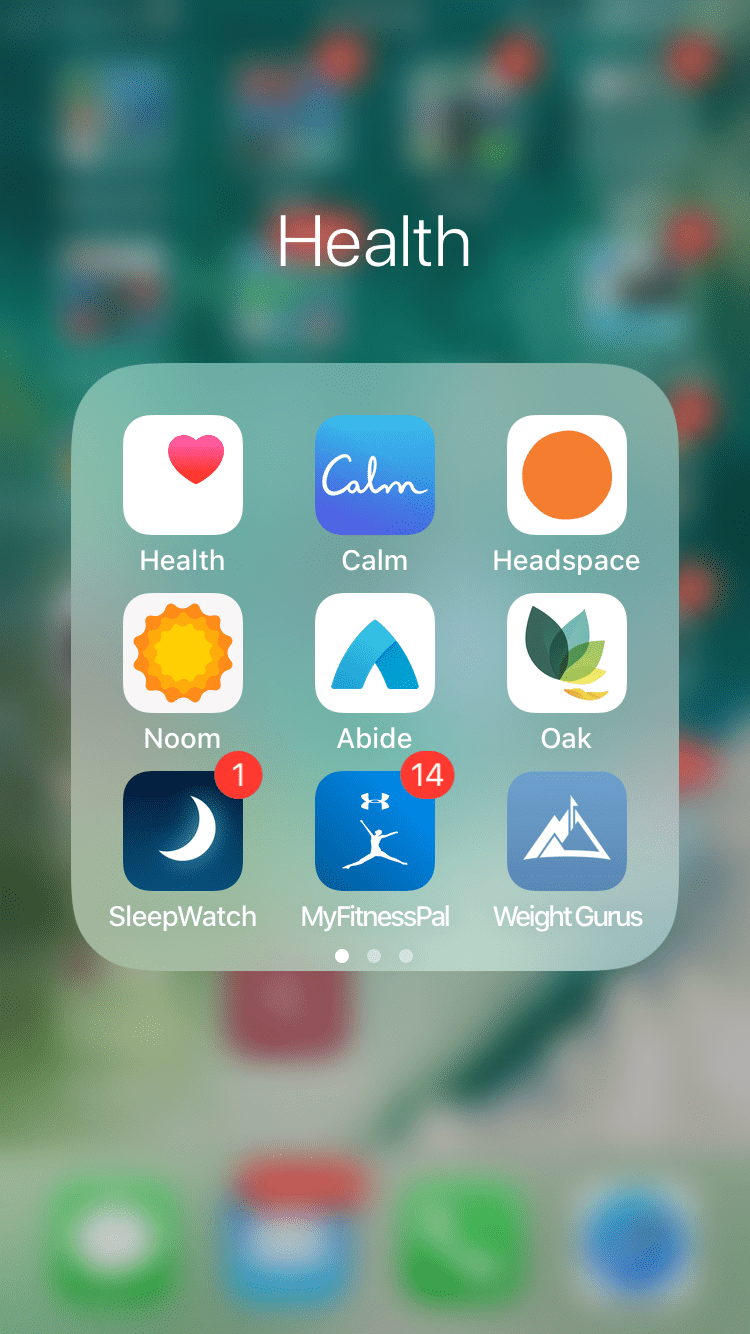
I mentioned the value of meditation in the previous post and since I had zero knowledge of meditation, I just use an app for that. I still don’t consider myself to have any understanding of meditation, but I love listening to the content on Calm, Oak, Abide, Headspace. The other night, Calm told me I had listened to their app 500+ times. Wow! I had no idea. I also love Amazon’s Audible and audiobooks. You might like podcasts, but I find that listening with my eyes closed is a great way to relax at night.

Noom exists solely in an app. Unlike other digital support systems like MyFitnessPal and WeightGuru which have corresponding websites, there is no website interface for Noom. It’s only available in an app.

So, get your tech set. Upload all your data into your apps. And even if you have zero plans to eat healthy, once you know exactly what you’re eating and how much you’re moving and how those two balance out, you almost can’t help but start tweaking it.

Early on with MyFitnessPal, I had a crazy urge to eat something delicious. But when I put it in the app, I was shocked how much calories, fat, sugar, etc. Then I considered whether a half of quarter serving of the same dessert might not hit the spot. I ate a fraction of what I was planning on eating and felt really happy with having eaten it. I undoubtedly would have eaten the whole thing if I hadn’t put it in the app first. I tend to do that a lot. I’ll think about eating something and wonder if it’s going to give me sufficient fiber or protein and if the numbers don’t add up like I want, I make another food choice.

That’s another detail. I don’t avoid carbs, fat, calories, etc. I chase protein and fiber. But that’s part of the food discussion, so I’ll cover that next time. For now, just set up your tech. Download all the apps. Tryout some meditation. Start logging food. Give your Apple Health permission to record your exercise, steps, hours standing, etc. Give it permission to share that information with your Noom app.

Buy a WiFi enabled scale. Step on it naked every day just after you wake up. Buy some kind of wearable (watch) that tracks your steps, health, heartrate, sleep quality. I talked about the options in the previous post: iWatch ($300?), FitBit ($140?) and HuaWise ($28).

Sleep & Tech 1st. Worry about food and exercise later.

Happy Health!

Diet, Weight loss, Meditation & Sleep

I didn’t take a New Year’s resolution for 2019, so I’m not exactly sure how it happened, but I dropped from 160 pounds to 135.

Let me try to recount the sequence of events not only for the readers, but because I haven’t always been cognizant of the comprehensive nature of all the interlocking decisions I’ve made.

Obviously, I was unhappy with my body weight and so was my doctor. I gave birth in early 2016. Prior to the pregnancy, I was 125 pounds. I’m 5’3 3/4″. While working with a fertility doctor, the medications I took to try to help me get pregnant caused me to gain 15 pounds. I lost 7 pounds after stopping the meds, but stopped trying to diet when it looked like our attempts at pregnancy might be successful. I didn’t want to risk losing a chance at a child. During the pregnancy, I topped out at 170 pounds and afterward while breastfeeding, the pounds melted off, dropping to 136 7 or 8 months after giving birth. However, once I stopped breastfeeding, the weight came back.

For a couple of years, I played yo-yo and tried numerous diets, the most successful of which was Jenny Craigs, but I never managed to keep the weight off. In addition to weight problems, our daughter didn’t sleep through the night until around 3 1/2 years old. We were horribly sleep deprived. I read a lot about the damaging effects, including weight gain of insufficient or bad quality sleep. I also read the book The Secret Life of Fat. Finally, I joined Noom and announced on Facebook that I was going to get 125 pounds back.

I haven’t. I’m still 10 pounds away, but I have become confident that I can. Step 1 was a wearable and a focus on sleep.

After joining Noom, the counselor asked me what I wanted to focus on and I said 8 continuous hours of sleep with 60% deep sleep and average heart rate dip, which is 20% or more. This was an odd goal for a weight loss program, but to their credit, the Noom team didn’t balk. I said I’d work on weight loss after I mastered sleep.

The Sleep Craze
I bought an iWatch. Later I wished I would have bought a $28 HuaWise Fitness Tracker, Waterproof Activity Tracker with Heart Rate Monitor and Sleep Monitor, Waterproof Pedometer, Step Counter, Calories Counter for Android & iPhone. My niece, her boyfriend and my nephew all have fitbits, which are also cheaper than an iWatch. Neither the HuaWise nor the fitbit requires a monthly cellular service charge. Also both fitbit and HuaWise only need to be charged once per week. I constantly fight to keep my iWatch charged, but regardless, some kind of wearable that tracks steps, heartrate, sleep and so on provides critical feedback for both sleep and weight loss management.

I read a lot of blogs, add a black paper accordion folded shade with super sticky glue behind my blinds. I made my room super dark and increased the air condition to make deeper sleep more likely. (Original Blackout Pleated Paper Shade Black, 36” x 72”, 6-Pack by Redi Shade) I guarded my sleep religiously, stopping all action outside the home by 6 p.m. to be able to get the toddler bathed, fed and relaxing in bed by 8 p.m. so I could consistently fall asleep between 8:30 and 9 p.m.

I quit caffeine. No shit! The most extreme part of this whole 9 month process has been eliminating my chemical dependence. It was painful. Headaches. And it took me a while to switch to Diet Sprite or 7 Up or Diet A&W root beer, but after 3 or 4 months, I had the impression that I had actually won. Another goal that Noom didn’t argue with, but simply supported.

I stock several sleep aids. Chamomile tea is the best but tastes horrible. Sleepy Time tea tastes better, but doesn’t seem to be quite as powerful. I gave up on melatonin which is great for changing time zones, but doesn’t keep me asleep. When my mind is restless and I can’t sleep within 20 minutes of laying down, I take dreamwater, luna or sleepy bear gummies. Dreamwater has melatonin with GABA and other stuff. Luna’s advertisement says: made with Herbal Extracts such as Valerian, Chamomile, Passionflower, Lemon Balm, Melatonin & More. The Amazon description for sleepy bear gummies says: Formulated with Melatonin, the berry-flavored chewable gummies also include our proprietary Rest Well Blend consisting of Lemon Balm Leaf, Passion Flower, Valerian Root, and 5-HTP.

But I started meditating. I use several apps: Calm. Oak. Headspace. There are more. I ignore the part about sitting in the lotus position imaging a string above my head holding me straight up, relaxed but alert. I lay in my bed, one leg over a body pillow with the smart phone beside my pillow and most nights I’m asleep before I finish the meditation. Of course, if the meditation works, no need for sleep aids, but if I’m still awake 20 minutes after laying down, I don’t think twice, I just sleep aid. Nothing is going to keep me from hitting that 9 p.m. deadline.

In order to hit my heart rate dip and deep sleep requirements, I discovered that I must do at least 12k steps per day. If not, my sleep quality suffers. What’s more, it doesn’t matter if I jog or stroll. However, unlike the Marines taught me, 3 miles per day is not enough. I usually log something closer to 7 miles per day in order assure quality sleep. Of course, this amount of movement also helps with weight loss. But even if operating in a caloric deficit, a sleep deprived body can hold on to weight. I don’t know why. I don’t know how. But I have seen over the last 9 months that even if I do everything else right, but my sleep isn’t good, the weight will not come off. This might be because of the incredible power of intermittent fasting. Of course, sleeping people don’t eat.

I’ll do more weight loss posts with information regarding food and daily habits, but for now, sleep well!

not be judged by the color of their skin but by the content of their character

My husband and I are struggling with a parenting question. Bin is from China where people are judged based on their party affiliation or connection to political power, which is really one in the same. His upbringing taught him that people are their socioeconomic class, the names of the various educational institutions where they studied. In Bin’s words, “In China, people judge by your parent’s social status and money.”

He brings his references to our painful struggle to decide which school district to move to so our daughter will have a good education. I told him I’d like to move to the school district where my colleague’s son just graduated high school and was selected to all 3 of the service academies in the United States – West Point, the Naval Academy and the Air Force Academy. The problem is, my colleague’s son was most probably the only student from that school who was so honored. So it was not the name of the institution on his application that got him accepted. I assume most universities are looking for the content of the character of the students they select.

Of course, content of character is subjective and difficult to judge. But what it is almost certainly not is a list of attributes that actually have nothing to do with the individual knowledge, skills and abilities of that one student. A list like family class, ethnicity, gender, political connection and other elements of the “accident of birth.”

I’m going to go back to my case example, my colleague’s son. But let’s start with my colleague, Norris Agnew, born 40+ years ago in rural Mississippi as an African-American male. And since that time, he served in Okinawa, Japan (2 yrs), South Korea (1 yr); Belgium (2 yrs); mainland Japan (6 yrs); Germany (3 yrs). He spent more time was overseas than stateside. He has traveled the world over in 20+ years with the U.S. Air Force. He has become, in an overused and trite term, cosmopolitan. He’s still American, but he’s also international and transnational. He’s an award winning broadcaster and a former instructor at the DOD school of journalism with a master’s degree from John Hopkins. He’s married to a lovely Korean woman.

This sets the background for his son, who was raised bilingual Korean-English. Undoubtedly at least one of the attributes the military service academies saw in him was his native fluency in the language of one of our greatest adversaries, North Korea, and one of our strongest allies, South Korea. I assume his SAT scores and grades were extraordinary, but so are all the grades and scores of students applying to the Ivy League, and yes, I consider the service academies on par with the Ivy League. He was also an extraordinary athlete and the captain of his school’s football team several years running. He also served in the Civil Air Patrol. Obviously military academies as well as all universities are looking for applicants who display leadership capabilities and potential. So his leadership in sports and in the Civil Air Patrol would have made him an attractive candidate. Additionally, physical fitness is a critical element of the military lifestyle, so his athletic skill undoubtedly contributed to his selection.

All this is to say: What resulted in his selection was not his political connections, tribal affiliation which equates in the vernacular of the United States, ethnicity, or his socioeconomic status. In fact, all of those factors are what the founding fathers of the United States would have dubbed, “the accident of birth.”

This makes me think of the MLK speech, I have a Dream, because Martin Luther King, Jr. tapped into something that is fundamentally American. He tapped into the idea that each of us is more than the sum of our social ties. We all have unique, intrinsic elements of our personalities that contributes to the content of our character.

So, I understand that my job as a parent is to help my daughter embrace and develop the specific knowledge, skills and abilities which come to her most naturally and which build for her an independent sense of herself. Her schools and instructors are important in so much as they support that goal, but the specific name on her transcripts isn’t what makes her special. It’s how she combines her experiences and understanding into a human being that transcends them.


The Guyger case speaks to a general sense of the lack of physical safety for POC

I’ve been reading posts in a Facebook group called Woke and Aware, which discusses “current racial injustices, while sharing information that will SUPPORT the overall well being (mind, body, & spirit) of Black people & Black communities.”

In my sincere desire to learn, understand, and become actively supportive, I combined conversations from Woke and Aware about the Amber Guyger case with comments about racial issues from deeply admired friends and work-teammates. In the case, Guyger, a white off-duty police officer, walked into the wrong apartment and shot its Black resident, Botham Shem Jean, and claimed that she thought he was an intruder in her apartment. Botham was a father, husband, brother, son, a church leader known for his singing voice and an accountant. He was 27 years old. 

I was pondering what happened and people’s reaction to it and suddenly it all clashed together in my head at 2 a.m. after I’d fallen asleep before 9 p.m. The iconic image from the 2014 Ferguson protests lingered in my semi-conscious mind. “Twelve-year-old Devonte Hart was holding a sign offering “free hugs” during a protest in Portland, Oregon against a grand jury’s decision not to charge white officer Darren Wilson for killing unarmed black teen Michael Brown. The image, shot by freelance photographer Johnny Nguyen and published by The Oregonian, showed a man identified as Portland Police Sgt. Bret Barnum hugging Devonte as tears streamed down his face,” according to the British online newspaper the Independent.

Some 18 months before the Guyger case, a colleague told me he never went out in less that business casual. I had prompted this conversation by telling him my husband worried about police encounters after seeing all the press because he’s an Asian person of color with imperfect English. My colleague suggested I give my husband the same advice he raised his son with, that is never to leave home wearing less than business casual clothing to avoid ugly incidents. In the 18 months since that conversation, I think about his words every time I run out to get milk or gas the car in jogging shorts and Tevas. But suddenly, at 2 a.m., I pondered what exactly defined an ugly incident and the Mwende “FreeQuency” Katwiwa TED talk had the answers. Maybe it’s just someone looks at you as a criminal rather than a child, in the case of my colleague’s son. Maybe someone is just rude or suspicious. But maybe … a family member doesn’t come home … ever.

During the discussions of Guyger trial, I had a private conversation with a mother of three sons whose young adult nephew had been living with her family when he was killed a month earlier in a senseless act of violence. I realized during our conversations that her family wasn’t simply mourning the loss of a family member, but I worried and wondered if her children believed they could be next. She told me she had been diagnosed with PTSD. We discussed whether maybe her children might be struggling as well.

I suddenly realized the Guyger case, independent from the facts of the case, is part of a greater social reality for People of Color in which there is a general sense of lack of physical safety. A sense of physical safety is one of the most important elements to human development after food, clothing and shelter. An Army special forces medic once explained to me that people can get PTSD not only from experiencing violence or witnessing it, but from the pervasive fear that violence is a constant threat.

Now we leave the battle fields of Iraq/Afghanistan and come to the U.S.  Here, we view the perception of physical safety in communities of Non-Whites after the string of videos showing random violence, police brutality, unarmed Black people killed by police, added to the senseless death of Botham and the end result is unquestionably a sense the world is not safe in the poetry of Mwende “FreeQuency” Katwiwa, “if you’re Black in America.”

Unlike the battle fields of foreign lands, the fear here isn’t only that sudden, senseless death might come to an individual or someone they know, but here it could be a family member, loved one or in the worst case of fear, a child.

We not only need a justice system that actually treats everyone equally with equal time for equal crime; we not only need police forces that engender trust among all; we need a sense of physical safety for everyone, including and especially People of Color. We need a sense that we are all physically safe in our homes. This is the underlying meta reality of  Guyger shooting Botham. People of Color are not even physically safe in their own homes.

I know we all live in our own skin and we can only know the lived experiences of others by listening. I’m trying to listen, process, learn and understand.